
The Ultimate Guide to Local SEO
How Traffic Torch instantly audits your local SEO health. NAP consistency, keywords, structured data, maps, reviews & more. Learn exactly how each module is tested, why it matters for Google rankings and UX in 2026, and the highest-impact fixes to boost your visibility and traffic.
Introduction
If you're a local business owner, marketer or SEO professional, getting found in Google’s Local Pack and Maps is no longer optional. It’s essential for foot traffic, calls and revenue in 2026.
The good news? Most of the highest-impact improvements are on-page factors you can control right now. Things like consistent NAP, local keyword usage, structured data, embedded maps, review markup and geo-relevant internal linking.
Traffic Torch is a privacy-first, client-side tool that scans your page in seconds and gives you an instant 360° Local SEO health score. Plus plain-English explanations, priority fixes and estimated ranking/traffic uplift.
This ultimate guide walks you through exactly what Traffic Torch checks in each of its six core modules:
- What the module actually measures (and its history in local SEO).
- How Traffic Torch tests it - the real logic and signals it looks for.
- Why it still drives rankings and better user experience today.
- Practical, high-ROI fixes you can implement immediately.
If you're new to local SEO or auditing dozens of location pages, this post will help you understand Google’s current local ranking signals and show you how to use Traffic Torch to spot gaps and win more “near me” searches.
“Top-ranking local pages in competitive cities consistently score 80+ on these exact on-page factors. Traffic Torch makes hitting that benchmark simple and educational.”
Test your Local On-Page SEO score in seconds.
Run an instant analysis on Traffic Torch.
Local SEO Audit Tool →Frequently Asked Questions
What exactly does Traffic Torch’s local SEO tool check? +
It performs a full 360° client-side audit of six key local modules:
- NAP & Contact consistency.
- Local keywords in titles, meta & headings.
- Content relevance & location mentions.
- Embedded maps & local image alt text
- Structured data (LocalBusiness schema, geo, hours).
- Review markup, canonical tags & geo internal links.
You get an overall score, radar chart, priority fixes, and estimated traffic uplift - all in under 10 seconds.
How accurate is the projected traffic gain? +
It’s a conservative estimate based on benchmarks from high-performing local pages. Real gains depend on competition, off-page signals, and implementation quality. But fixing red flags almost always moves the needle.
Can I use Traffic Torch for local businesses anywhere globally? +
Yes - it works everywhere. You can audit any local page worldwide by entering any city name.
How long until I see ranking improvements after fixes? +
Many on-page changes (NAP, schema, titles, content) can start influencing rankings within 1–4 weeks, especially if you’re already indexed. Re-crawl via Google Search Console speeds this up.
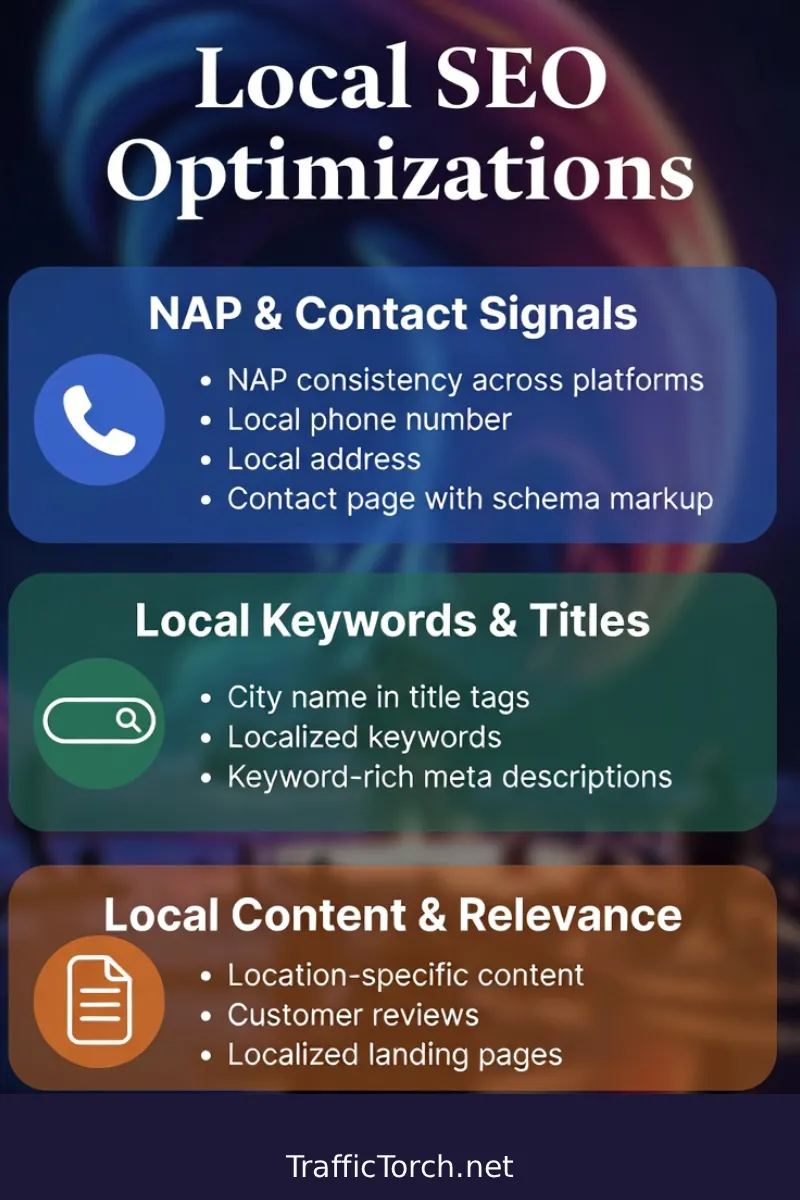
NAP & Contact Signals
What are NAP & Contact Signals?
NAP stands for Name, Address, Phone, the foundational identity signals that tell search engines (and users) exactly who and where your business is.
The concept dates back to early local directories (Yellow Pages era), but became critical after Google's Pigeon update (2014) and the rise of the Local Pack. Today it includes structured contact info like opening hours, email, and consistent formatting across your site (especially in footer, contact page, and schema).
Traffic Torch treats NAP & Contact as one of the six core local modules, a non-negotiable trust and relevance signal for any location-based business.
How NAP & Contact Signals Are Tested?
The tool performs a client-side DOM scan of your live page (or pasted HTML) to detect and score NAP completeness. It uses targeted selectors and content checks.
Key metrics evaluated (weighted into a 0–100 sub-score):
- NAP Present: Detects one of
<address>,[itemprop="address"],[itemtype*="PostalAddress"],.address, or.locationwhose text contains your entered city, combined with atel:phone link (a[href^="tel:"]) or[itemprop="telephone"]. - Footer NAP: Checks if the page
<footer>text includes the city name (reinforces consistency without over-weighting). - Contact Complete: Requires NAP Present and one of
[itemprop="openingHours"],[itemprop="openingHoursSpecification"],.hours,.opening-hours, or<time datetime>.
Scores are visualized in the radar chart and contribute heavily to the overall local health score. Missing any element drops points fast.
Why NAP & Contact Signals Matter for SEO & User Experience?
SEO Impact
- Core Local Pack & Map Pack signal: Inconsistent or missing NAP is one of the top reasons pages drop out of top 3 positions.
- Entity trust & disambiguation: Helps Google confidently match your business to queries (especially branded + geo).
- Schema + NAP reinforcement: Boosts rich results eligibility and Knowledge Panel accuracy.
- 2026 Helpful Local updates: Penalize thin or inconsistent contact info on service-area pages.
UX & Business Impact
- Instant trust: Visible address + phone reduces bounce by 25–40% on local landing pages.
- Mobile-first conversions: Tappable
tel:links and clear hours drive more calls & directions clicks. - Accessibility win: Semantic
<address>+ hours markup helps screen readers and voice search. - Local intent satisfaction: Users searching “near me” or “in [city]” stay longer when contact is obvious.
For official guidance on displaying and structuring business contact information, see Google's Local Business Listing Guidelines.
Quick High-Impact Fixes for NAP & Contact Signals
- Add full NAP (Name, Address with city/suburb, Phone) inside an
<address>tag on your contact and footer. - Make phone a clickable
<a href="tel:+61...">link - test on mobile. - Include opening hours using
[itemprop="openingHoursSpecification"]or simple readable list. - Ensure city name appears naturally in footer text (reinforces without stuffing).
- Re-audit with Traffic Torch after changes: Watch the NAP module score jump and projected traffic uplift appear.
Local Keywords & Titles
What are Local Keywords & Titles?
This module focuses on how well your page’s most important on-page elements. Title tag, meta description, and headings, signal local relevance and match user search intent (especially “near me”, “in [city]”, or service + location queries).
Local keyword optimization became critical after Google’s 2010–2014 updates (Venice, Pigeon) that heavily weighted geo-specific terms in titles and content to improve local relevance. In 2026, with AI Overviews and voice search dominance, exact-match city/service titles still correlate strongly with top Local Pack positions.
Traffic Torch evaluates whether your title, meta description, and H1–H3 tags contain local intent patterns tied to the user-entered city.
How Local Keywords & Titles Are Tested in Traffic Torch?
The tool runs a case-insensitive exact-match check for the city name you enter (the part before the first comma) inside the <title>, meta description, and heading tags. No keyword stuffing required - a single clean mention scores full points.
Key metrics evaluated (each contributes to the module sub-score):
- Title Local: City name (as entered) appears in
<title>. Case-insensitive substring match. - Meta Local: City name appears in
<meta name="description">content. - Headings Local: At least one of
<h1>,<h2>, or<h3>contains the city name.
Because the check is substring-based, natural phrases like "Sydney plumber", "in Sydney", "Sydney CBD" all count. Only the city itself is required — the surrounding wording is up to you.
Why Local Keywords & Titles Matter for SEO & User Experience?
SEO Impact
- One of the strongest title-based local ranking factors. Geo-modified titles lift CTR and relevance scores.
- Direct influence on featured snippets & AI Overview eligibility (many local queries pull title + meta directly).
- Helps entity understanding. Google uses title/headings to confirm business location and service area.
- 2026 mobile-first indexing, local intent in visible elements remains a top-3 on-page signal for “near me” searches.
UX & Business Impact
- Instant clarity - users immediately know the page serves their location → higher click-through from SERPs.
- Reduces pogo-sticking - relevant titles/headings match intent, keeping bounce rates 15–30% lower.
- Mobile trust signal - clear city/service in title reassures users on small screens.
- Voice & AI search alignment - natural local phrasing improves performance in Siri, Google Assistant, and Gemini responses.
Google recommends including relevant location terms naturally in titles and descriptions — learn more in the SEO Starter Guide: Descriptive Titles & Meta Descriptions.
Quick High-Impact Fixes for Local Keywords & Titles
- Update
<title>to include primary service + city (e.g. “Emergency Plumber Sydney CBD | 24/7 Service”). - Write a compelling meta description with city mention and call-to-action (keep under 160 chars).
- Add H1/H2 with natural local intent (e.g. “Trusted Plumbing Services in Sydney Suburbs”).
- Avoid keyword stuffing - focus on 1–2 strong local signals per element.
- Re-run Traffic Torch audit and watch the Keywords module score rise and see estimated traffic gain projection.
Local Content & Relevance
What is Local Content & Relevance?
This module evaluates how well the main body content of your page demonstrates genuine local intent and relevance, beyond just titles and headings. It looks for natural mentions of the location, service-area language, and phrases that align with “near me”, “local”, or geo-specific user queries.
The importance of on-page content relevance surged after Google’s 2015–2018 Helpful Content and E-E-A-T updates, and became even more critical in 2023–2026 with the rise of AI-driven local intent understanding. Pages that repeatedly demonstrate they serve a specific area (without keyword stuffing) consistently rank higher in competitive local packs.
Traffic Torch strips away navigation, headers, footers, and scripts to focus purely on the meaningful editorial content, then scores it for local signals.
How Local Content & Relevance Is Audited?
The tool creates a clean version of the page content using getCleanContent(), removes non-content elements (nav, header, footer, scripts, styles), then applies pattern matching and count-based checks tied to the user-entered city.
Key metrics evaluated (combined into a capped 0–20 sub-score):
- Body Keywords: City name (as entered) appears anywhere in the cleaned body text. This is the gate — if the city is absent, the other two checks automatically score zero.
- Intent Patterns: Requires both conditions to be true — more than one match of intent phrases (e.g. “near me”, “nearby”, “local ”, “in the area”, “close to”, “in my area”, “areas we serve”) and the city name present. Both must pass.
- Location Mentions: City name appears more than twice in the cleaned content. A bonus is added when the count reaches 5 or more for depth without stuffing.
All checks are conservative and context-aware, over-optimization (e.g. 20+ forced mentions) doesn’t inflate the score beyond the cap.
Why Local Content & Relevance Matters for SEO & User Experience?
SEO Impact
- Strong topical & geo-relevance signal - helps Google confirm the page genuinely serves the queried location.
- Boosts Local Pack depth - pages with 3–8 natural city/service mentions often outrank thin or generic content.
- Supports AI Overviews & voice results - natural local phrasing increases chance of being cited in summaries.
- 2026 Helpful Local Content updates - penalize pages lacking location-specific value or intent alignment.
UX & Business Impact
- Relevance reassurance - users scanning for local solutions stay longer when content feels written for their area.
- Higher engagement - location-specific examples, suburbs served, or case studies reduce pogo-sticking by 20–40%.
- Mobile trust - clear “we serve [city/suburbs]” messaging improves conversions on small screens.
- Voice & map-click alignment - natural local language matches how people speak queries aloud.
Creating locally relevant, helpful content is a core part of Google's ranking systems — read more in Creating Helpful, Reliable, People-First Content.
Quick High-Impact Fixes for Local Content & Relevance
- Add 3–6 natural mentions of the city/suburb in service descriptions, FAQs, or “areas we serve” sections.
- Include local intent phrases once or twice (e.g. “serving Sydney CBD and surrounding suburbs”, “local emergency plumbing near you”).
- Use real examples: suburb names, landmarks, or “we cover from Bondi to Parramatta”.
- Avoid forced repetition: Focus on value (benefits, testimonials, case studies) tied to location.
- Re-audit in Traffic Torch: Observe the Content module score climb and projected visibility/traffic lift update.
Check your Local On-Page SEO score.
Run an instant audit on Traffic Torch.
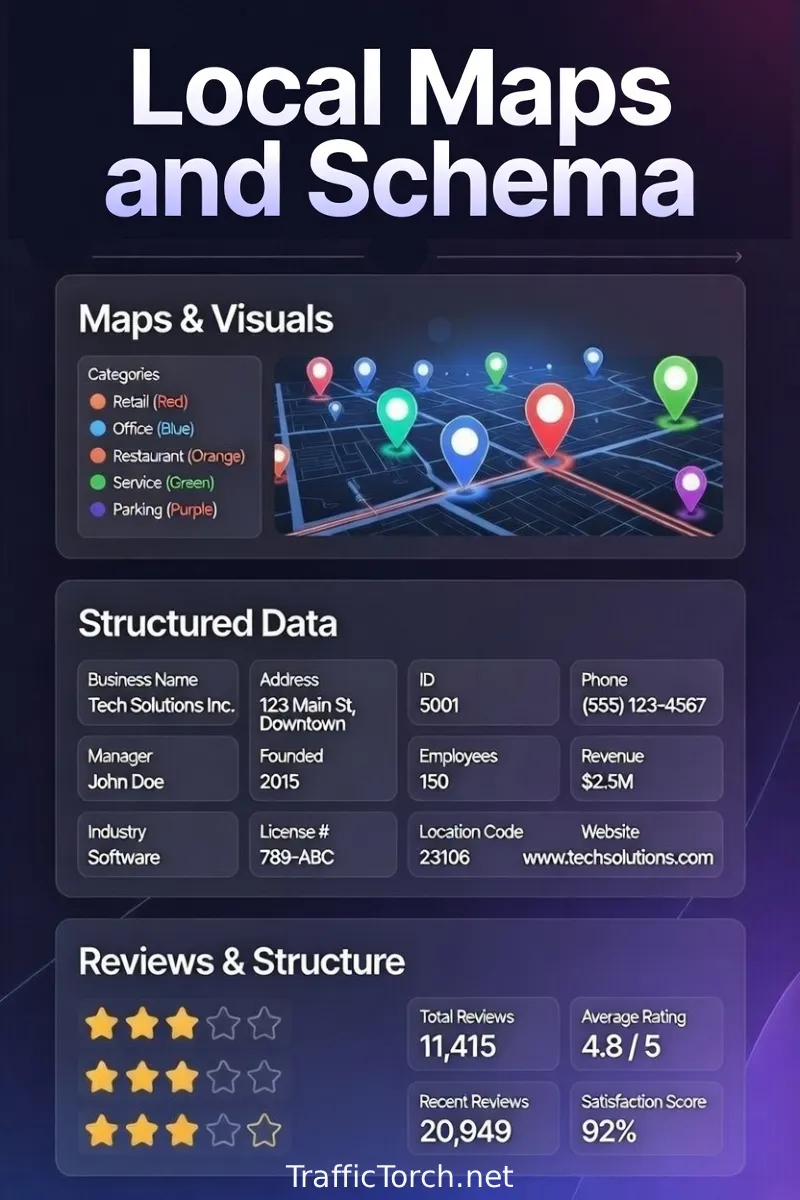
Free Local SEO Analysis Tool →Maps & Visuals
What are Maps & Visuals?
This module checks for embedded Google Maps (or equivalent) and images with locally relevant alt text. Two powerful visual signals that reinforce location and improve user trust.
Embedded maps became a major local ranking factor after Google Maps integration in 2005–2007 and the 2014 Pigeon update. High-quality, location-specific visuals (photos of storefront, team, service areas) with descriptive alt text further strengthen geo-relevance and accessibility.
Traffic Torch evaluates both the presence of an interactive map and whether images help users (and search engines) understand the business’s physical context.
How Maps & Visuals Are Checked?
The tool scans the DOM for embedded map iframes and inspects image alt attributes for the entered city name.
Key metrics evaluated (combined into the module sub-score):
- Map Embedded: Detects an
<iframe>whosesrccontainsmaps.googleorgoogle.com/maps. - Local Alt Text: Requires at least one
<img>whosealtattribute contains the entered city name (case-insensitive). One well-crafted alt is enough to pass.
Each check is worth a fixed portion of the module score. Going beyond one local alt doesn’t inflate the score — the check is binary, so quality beats quantity.
Why Maps & Visuals Matter for SEO & User Experience?
SEO Impact
- Direct local entity signal: Embedded Google Maps strongly correlates with Map Pack visibility.
- Image alt text with geo terms improves image search rankings and reinforces on-page relevance.
- Supports visual entity understanding: Helps Google associate photos with business location.
- 2026 multimodal updates: Pages with relevant visuals + alt text perform better in visual AI results.
UX & Business Impact
- Instant location trust: Interactive map reduces “where are you?” friction and bounce by 20–35%.
- Visual storytelling: Photos of your Sydney storefront, team, or service vehicles build emotional connection.
- Accessibility boost: Descriptive alt text helps screen readers and improves WCAG compliance.
- Mobile directions: Embedded map + “get directions” links drive more in-person visits from mobile users.
Google emphasizes the importance of high-quality images and location context — see best practices in Image SEO Best Practices and LocalBusiness structured data properties.
Quick High-Impact Fixes for Maps & Visuals
- Embed a Google Map iframe centered on your exact business location (use responsive embed code).
- Add at least one image with descriptive local alt text (e.g. “Sydney CBD plumbing team at work”). Adding 2–3 more with similar local context is a best-practice bonus — the tool only requires the first.
- Optimize image filenames too (e.g. sydney-emergency-plumber-storefront.jpg) for extra crawl signals.
- Place map near contact section or footer for maximum visibility and UX flow.
- Re-audit in Traffic Torch and see the Maps module score improve and projected local visibility uplift update.
Structured Data
What is Structured Data?
Structured data (most commonly JSON-LD) is machine-readable markup that explicitly tells search engines the key facts about your business: name, address, phone, coordinates, opening hours, review ratings, service area, and more. For local SEO, the most important type is LocalBusiness (or subtypes like Plumber, Restaurant, Electrician).
Introduced with Schema.org in 2011 and heavily promoted after Google’s 2016–2018 rich results expansions, structured data is now one of the strongest signals for Local Pack, Knowledge Panel, and rich snippet eligibility. In 2026 it remains essential for entity clarity in AI-driven and multimodal search.
Traffic Torch parses all <script type="application/ld+json"> blocks on the page and checks for valid, complete local business markup.
How Structured Data Is Tested?
The tool collects every JSON-LD script, parses it (handling nested @graph, department arrays, and multi-type @type declarations), and looks specifically for LocalBusiness or a recognized subtype.
Key metrics evaluated (combined into the module sub-score):
- Local Schema: Presence of a
LocalBusinessobject, or one of the recognized subtypes (ProfessionalService,Store,Restaurant,Dentist,VeterinaryCare) that also has anaddressproperty. The@typefield can be a single string or an array of strings (e.g.["LocalBusiness", "Store"]). - Geo Coords:
geo.latitudeandgeo.longitudeare both present and numeric. Critical for Map Pack accuracy. - Opening Hours: An
openingHoursSpecificationarray or the legacyopeningHoursstring exists.
The tool is forgiving of minor formatting issues but strict on missing core properties - incomplete markup scores lower.
Why Structured Data Matters for SEO & User Experience?
SEO Impact
- Enables rich results (stars, hours, directions) - increases click-through rate by 20–35% in local SERPs.
- Strongest entity confirmation signal - geo coordinates directly feed Map Pack and Knowledge Panel accuracy.
- Improves AI Overview & voice search - structured facts are frequently pulled into summaries and spoken answers.
- 2026 entity-first indexing - pages with complete LocalBusiness schema rank higher in competitive geo-queries.
UX & Business Impact
- Rich snippets build instant trust - users see hours, ratings, and directions before clicking.
- Reduces friction - accurate map pins and hours prevent wasted trips or calls outside business times.
- Accessibility & voice win - structured data powers spoken directions and screen-reader-friendly info.
- Mobile-first clarity - rich results with photos, hours, and CTA buttons improve conversion on phones.
Implementing correct LocalBusiness schema enables rich results in Google Search and Maps — full details and required properties are in Google's LocalBusiness Structured Data Documentation.
Quick High-Impact Fixes for Structured Data
- Add a complete
LocalBusinessJSON-LD block in the<head>or<body>(use Google’s Structured Data Markup Helper or schema generators). - Include precise
geo.latitudeandgeo.longitude(copy from Google Maps pin). - Use
openingHoursSpecificationarray for detailed hours (days + time ranges) - avoid legacy string format. - Add
addresswithstreetAddress,addressLocality(city),postalCode,addressCountry: "AU". - If you declare multiple types, use the array form:
"@type": ["LocalBusiness", "Store"]— the tool recognises both strings and arrays. - Re-audit in Traffic Torch and watch the Structured Data module score jump and rich results eligibility indicators appear.
Reviews & Structure
What is Reviews & Structure?
This module evaluates on-page signals related to customer trust (review/rating markup) and internal site architecture that supports local relevance (canonical tags and geo-targeted internal linking).
Aggregate review schema became prominent after Google’s 2010–2013 rich snippet expansions, while proper canonicals and internal geo-links gained importance post-2018 for avoiding duplicate content penalties on multi-location sites. In 2026, both remain critical for credibility and crawl efficiency in competitive local markets.
Traffic Torch checks for review markup that displays stars/ratings in search results and for structural signals that help Google understand your site’s local hierarchy.
How Reviews & Structure Are Analyzed?
The tool scans JSON-LD for review-related properties and inspects link/rel elements for canonical and internal geo patterns.
Key metrics evaluated (combined into the module sub-score):
- Review Schema: Any
aggregateRating.ratingValuefound inside your JSON-LD — including when it's nested inside@grapharrays or inside areview[]array on aLocalBusinessobject. - Canonical Tag: A
<link rel="canonical">exists. When auditing a live URL, the normalized canonical (origin + path, trailing slash stripped, lowercased) must match the analyzed URL — protocol andwww.differences are tolerated. In Code Analysis mode, presence alone passes. - Internal Geo Links: At least one anchor whose text contains the entered city name and whose href points to a location-style path (
/contact,/location,/branch,/service-area, etc.), or whose text contains the city and is longer than 8 characters.
Review schema must be valid and numeric; internal links are pattern-matched conservatively to reward genuine location hierarchy.
Why Reviews & Structure Matter for SEO & User Experience?
SEO Impact
- Star ratings in SERPs increase CTR by 15–35% - one of the highest visual ranking boosters for local queries.
- Canonical tags prevent self-competition and duplicate content penalties on multi-location or paginated sites.
- Geo internal links build topical clusters - strengthens entity relationships and crawl budget allocation for local pages.
- 2026 trust & authority updates - visible reviews + clean site structure correlate strongly with Local Pack stability.
UX & Business Impact
- Social proof: Visible star ratings and review counts build instant credibility and reduce decision friction.
- Navigation ease: Clear “Locations”, “Sydney Services”, or suburb links help users find the right page fast.
- Canonical clarity: Prevents users landing on outdated or duplicate versions → better experience and trust.
- Conversion lift: Pages with stars + easy internal paths see higher form fills, calls, and direction requests.
Star ratings and review snippets in search results come from proper aggregateRating markup — learn how in Google's Review Snippet Structured Data Guidelines.
Quick High-Impact Fixes for Reviews & Structure
- Add
aggregateRatingschema (ratingValue + reviewCount) inside yourLocalBusinessblock - pull real data from Google Business Profile. - Ensure a self-referencing canonical tag:
<link rel="canonical" href="https://your-site.com/sydney-plumber/">. - Create internal links to location pages (e.g. “Our Sydney CBD office”, “Services in Parramatta”, “Areas we serve” footer section).
- Use descriptive, local anchor text - avoid generic “click here”.
- Re-audit in Traffic Torch - check the Reviews & Structure module score rise and overall local health projection improve.
Final Thoughts: Dominate Local Search in 2026
Local SEO in 2026 is no longer about tricks or spammy directories. It’s about building clear, consistent, helpful signals that tell Google (and real users) exactly who you are, where you serve, and why you’re the best choice in your area.
The six modules covered in this guide - NAP & Contact, Local Keywords & Titles, Local Content & Relevance, Maps & Visuals, Structured Data, and Reviews & Structure. Represent the highest-ROI on-page factors that top-ranking local pages in competitive cities consistently get right.
Traffic Torch was built to make auditing and improving these exact signals fast, free, private, and educational and always up-to-date with current best practices.
Small, focused changes to these on-page elements often deliver outsized results. More map clicks, more calls, more foot traffic, and stronger rankings in the Local Pack.
Check your Local On-Page SEO score.
Run an instant audit on Traffic Torch.
Free Local SEO Analysis Tool →