

Mastering SEO Intent: E-E-A-T, Depth, Readability & Schema
Search intent is now a top ranking factor in Google’s eyes, and it has been since the 2015–2023 Helpful Content & core algorithm updates. Matching what users actually want (not just what keywords they type) determines whether your page ranks in position 1–3 or gets buried on page 2+.
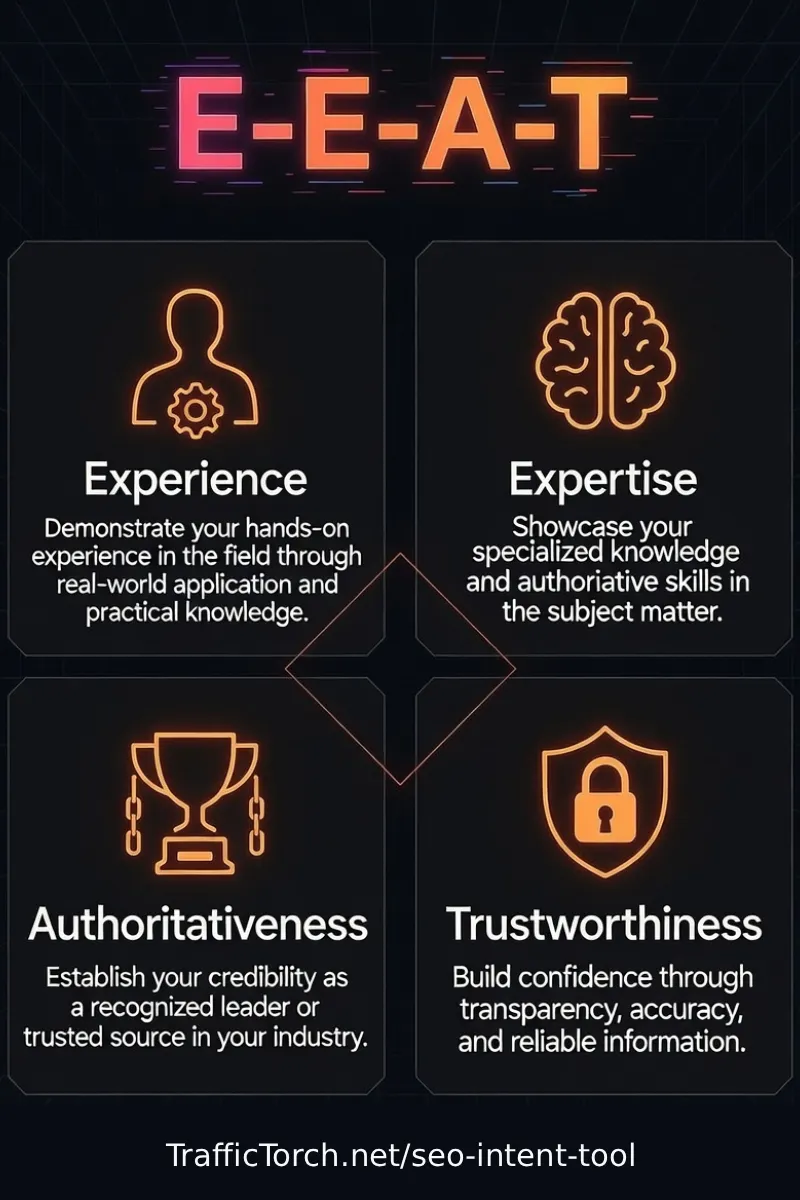
In 2026, Google rewards content that demonstrates strong E-E-A-T (Experience, Expertise, Authoritativeness, Trustworthiness), delivers real content depth, maintains excellent readability, and uses structured schema to communicate intent clearly to both users and search engines.
This complete how-to guide explains exactly what these four pillars mean today, how Google (and modern tools) evaluate them, why they matter more than traditional on-page tricks, and the precise, high-impact fixes you can implement right now to align your pages with searcher intent and climb the rankings.
If you’re optimizing blog posts, service pages, product descriptions or category landing pages, these principles apply universally. We’ll also show how Traffic Torch SEO intent analysis tool scores these exact signals in real time, and suggests AI-powered fixes so you can act fast.
Ready to turn vague “optimize for intent” advice into measurable, actionable improvements? Start with the modules below.
Test your SEO Intent and EEAT score in seconds.
Run an instant analysis with Traffic Torch. No signup. No tracking. Fully client-side analysis.
Run Free SEO Intent Audit →Frequently Asked Questions
Does Traffic Torch only work for blog posts or can it analyze product pages too?
It works on any public URL — blog posts, service pages, product descriptions, category pages, homepages. Schema detection adapts to context (e.g. Product schema on e-commerce, Article on blogs).
How long until I see ranking or traffic improvements after fixing these signals?
Typically 1–4 weeks after Google re-crawls and indexes changes (faster for frequently crawled pages). Use Search Console to request indexing. Biggest jumps often come from E-E-A-T + schema fixes.
Is schema markup still important even if I already rank well?
Yes — it’s one of the few ways to stand out in crowded SERPs with rich results, AI Overviews, and voice answers. Even top-ranking pages gain 20–50%+ CTR from proper schema.
Can I fix everything just by adding more words and first-person language?
No — depth without E-E-A-T or trust signals can still underperform. The tool shows balanced gaps so you prioritize the highest-impact fixes first (often trust + schema + author byline).
Experience - Showing First-Hand Knowledge
What is the Experience Pillar?
Experience is the newest addition to Google's E-E-A-T framework (turning E-A-T into E-E-A-T around 2022–2023). It emphasizes content created by people who have personally used, tested, lived, or observed the topic in real life.
This is especially important for YMYL topics (health, finance, safety, shopping) but increasingly affects all niches. Google wants to reward authentic, battle-tested advice over generic or purely theoretical content.
How Experience is Tested on Traffic Torch?
Traffic Torch parses the visible text content (after stripping scripts, styles, and hidden elements) and looks for clear signals of first-hand involvement. The tool calculates a combined 0–100 score based on these weighted metrics:
- First-person pronouns count (“I”, “we”, “my”, “our”, “I’ve”, “we’ve”, etc.) - >15 = excellent, >5 = good, low = weak.
- Personal anecdote & testing phrases (e.g., “in my experience”, “I tested”, “we found that”, “hands-on”, “real-world”, “after testing”, “my results”) - count and density.
- Timeline mentions tied to personal action (e.g., “last year I…”, “in 2024 we tried…”, “over the past 3 years” + first-person) - presence and relevance.
- Original personal media: Images/videos with alt/captions containing “my”, “our”, or clear personal context.
These are averaged into the final Experience sub-score shown in the tool’s radar chart and E-E-A-T breakdown.
Why Experience Matters for Rankings & UX?
Google’s Helpful Content and core updates (2023–2025) heavily penalize AI-rewritten or shallow content. Pages with strong Experience signals:
- Rank higher in competitive queries because they better satisfy real user intent.
- Reduce bounce rate and increase dwell time (users trust and read authentic stories).
- Earn more natural backlinks and social shares.
- Perform better in AI Overviews and voice/search features that prioritize helpfulness.
Bottom line: Experience turns generic info into trustworthy guidance, the difference between page 1 and page 3 in 2026.
Google emphasizes first-hand, real-world experience in content — see the updated E-E-A-T section in Search Central.
Quick High-Impact Fixes for Experience
- Add 10–20+ first-person references naturally throughout the content.
- Include 2–4 specific anecdotes or case studies with outcomes (“I tested X for 3 months and saw Y”).
- Reference real timelines (“Since updating in early 2025 we’ve seen…”).
- Embed original photos/videos with personal captions and descriptive alt text.
- Re-run Traffic Torch after changes to see the Experience score and projected uplift improve.
Expertise - Demonstrating Qualifications & Knowledge
What is the Expertise Pillar?
Expertise shows Google (and users) that the content was created or reviewed by someone with real, demonstrable knowledge in the subject. It’s the core of E-E-A-T for topics requiring skill, training, or deep understanding, especially YMYL pages, but increasingly important across all niches in 2026.
Google looks for visible proof: author attribution, credentials, qualifications, citations to reputable sources, and professional signals that separate expert content from generic or AI-compiled information.
How Expertise is Tested on Traffic Torch?
Traffic Torch scans the page HTML and visible text for clear expertise indicators, then computes a combined 0–100 score. The main weighted signals include:
- Visible author byline: Detected via common selectors (meta author, .author, .byline, [itemprop="author"], etc.) - presence = strong boost.
- Dedicated author bio section: Looks for blocks like .author-bio, .about-author, .writer-bio - with photo/background info = excellent.
- Credential keywords: Counts terms like PhD, MD, certified, licensed, years of experience, expert in, specialist, board-certified, 10+ years, veteran, professor, consultant, etc. - >2 strong mentions = high score.
- Citations & references: Presence of , .references, .sources, links to doi.org, pubmed, researchgate, or footer references section.
These four signals are averaged to produce the Expertise sub-score visible in the E-E-A-T breakdown and radar chart.
Why Expertise Matters for Rankings & UX?
Google’s quality raters and algorithms prioritize content from qualified creators to reduce misinformation, especially post-2023 Helpful Content Updates and 2024–2025 core updates.
- Pages with clear expertise signals rank higher in competitive and sensitive queries.
- Users stay longer, trust the advice more, and are more likely to convert or share.
- Strong author attribution + credentials improve click-through rates from SERPs (especially with rich results).
- Expert content attracts high-quality backlinks from authoritative sites.
- Reduces risk of manual actions or algorithmic demotions for low-quality / unverified advice.
In short: Expertise builds trust fast, turning visitors into readers and readers into loyal audiences.
Demonstrating true expertise is a core quality signal — read more in Google’s Search Quality Rater Guidelines overview.
Quick High-Impact Fixes for Expertise
- Add a clear, visible author byline at the top (name + optional title/photo).
- Create a dedicated author bio block at the bottom or in sidebar with credentials, photo, and short background.
- Weave in 3–5 relevant credentials naturally (“As a certified nutritionist with 12 years…”).
- Link to reputable sources, studies, or references — use or a sources section.
- Re-scan with Traffic Torch to watch the Expertise score rise and see estimated ranking/traffic uplift.
Check your SEO Intent and EEAT score.
SEO Intent Audit Tool →Trustworthiness - Transparency, Security & Reliability
What is the Trustworthiness Pillar?
Trustworthiness is the final pillar of E-E-A-T: It signals to Google and users that your site is safe, transparent, honest, and reliable. This includes clear contact information, privacy policies, up-to-date content, secure connections (HTTPS), and no deceptive practices.
In 2026, trust signals are critical for YMYL pages and increasingly influence all niches, as Google continues to combat misinformation, scams, and low-quality sites via core and spam updates.
How Trustworthiness is Tested on Traffic Torch?
Traffic Torch scans the HTML for on-page trust indicators using targeted selectors. It calculates a combined 0–100 score based on these key signals:
- Contact information links: Detects mailto:, tel:, /contact pages, or visible contact forms via selectors like a[href*="/contact" i], a[href*="mailto:" i].
- Privacy & legal policy links: Looks for /privacy, /terms, /legal, /disclaimer pages.
- Visible update or last-modified date: Finds time[datetime], .updated, .last-modified, meta[property="article:modified_time"], or similar freshness indicators.
- Implied security & transparency: Checks for HTTPS protocol (via page URL), no mixed content warnings, and presence of about/team/about-us links.
Presence of multiple signals yields a high score; missing key elements (especially contact + policies) significantly lowers the Trust sub-score in the E-E-A-T breakdown.
Why Trustworthiness Matters for Rankings & UX
Google explicitly lists trust as a core quality factor in its Search Quality Rater Guidelines and Helpful Content system. Strong trust signals:
- Improve rankings for sensitive or commercial queries where users need assurance.
- Reduce bounce rates — visitors feel safe clicking deeper or converting.
- Increase CTR from SERPs (especially when policies or contact info appear in snippets).
- Lower risk of manual spam actions or algorithmic suppression.
- Build long-term user loyalty and repeat visits.
Without clear trust elements, even excellent content can underperform, users (and Google) simply move on to more transparent sites.
Transparency, security (HTTPS), and clear contact info are foundational trust signals — detailed in Web Devs’s Site Security & HTTPS guidelines and E-E-A-T documentation.
Quick High-Impact Fixes for Trustworthiness
- Add visible contact links (email, phone, or /contact page) in footer or sidebar.
- Create and link Privacy Policy, Terms of Use, and Disclaimer pages (use free generators if needed, then customize).
- Display a clear “Last Updated” date near the top or bottom of the article.
- Ensure the site uses HTTPS everywhere and fix any mixed-content issues.
- Re-scan with Traffic Torch after updates to see the Trust score increase and projected traffic/engagement gains.
Content Depth & Topical Coverage
What is Content Depth in Modern SEO?
Content depth measures how comprehensively and thoroughly a page covers its main topic: Going far beyond surface-level answers to address user questions, related sub-topics, comparisons, examples, and edge cases.
In 2026, Google’s Helpful Content system and core updates heavily favor in-depth, value-packed pages over thin or duplicated content. Depth is a key proxy for satisfying search intent completely.
How Content Depth is Evaluated on Traffic Torch?
Traffic Torch analyzes the visible text content (after cleaning scripts, styles, hidden elements) and computes depth indicators. Key signals feeding into the depth score include:
- Word count & substance: Substantial length (typically 1200–3000+ words for competitive topics) with meaningful content (not filler).
- Sentence & paragraph variety: Mix of short/long sentences, varied structure to avoid repetitive or robotic patterns.
- Subheading hierarchy & coverage: Multiple H2/H3 sections that logically break down the topic into angles, FAQs, pros/cons, examples.
- Readability as a depth proxy: Flesch Reading Ease score (higher = more accessible depth, not overly complex).
These factors combine into the Content Depth component of the overall health radar chart and intent alignment score.
Why Content Depth Matters for Rankings & UX?
Google now ranks pages that fully resolve user intent: Shallow content gets pushed down or filtered out in favor of comprehensive resources.
- Deeper pages rank higher in informational and comparative queries
- Users spend more time on-page, reducing bounce rate and signaling quality to Google.
- Comprehensive coverage increases chances of featured snippets, AI Overviews, and “People Also Ask” inclusion.
- Depth builds topical authority, making it easier to rank for related long-tail keywords.
- Helps avoid Helpful Content Update penalties for “thin” or “unsatisfying” pages.
Depth isn’t about word count alone: It’s about delivering complete value so users don’t need to search again.
Comprehensive, in-depth content that fully satisfies intent ranks highest — see Google’s official helpful content guidance.
Quick High-Impact Fixes for Content Depth
- Expand to 1500–3000+ words by adding real examples, case studies, comparisons, and step-by-step breakdowns.
- Add 4–8 targeted subheadings (H2/H3) covering different angles, FAQs, pros/cons, common mistakes.
- Include original data, screenshots, tables, or infographics to support claims.
- Break up walls of text with short paragraphs, bullets, and varied sentence lengths.
- Re-run Traffic Torch to track the depth/readability improvement and see projected traffic uplift.
Readability & User Experience Flow
What is Readability in SEO & UX Context?
Readability measures how easily users can understand and consume your content — factoring in sentence length, word complexity, paragraph structure, and overall flow. It directly impacts user satisfaction, dwell time, and bounce rate.
In 2026, Google treats readability as a strong user-experience signal. Pages that are hard to read on mobile (long sentences, complex words) tend to underperform. Especially when users are scanning on phones.
How Readability is Calculated on Traffic Torch?
Traffic Torch extracts all visible text from the page body (excluding scripts, styles, hidden elements), cleans it, and applies the classic Flesch Reading Ease formula:
Readability = 206.835 − 1.015 × (total words / total sentences) − 84.6 × (total syllables / total words)
- Words: Count of meaningful words after trimming whitespace.
- Sentences: Detected via . ! ? punctuation (minimum 1 to avoid division errors).
- Syllables: Approximate count per word (vowel group matching, minimum 1 per word).
- Final score: Rounded integer — higher = easier to read (60–70 = plain English, 80+ = very easy).
The score appears in the health radar chart and contributes heavily to the overall on-page UX & intent match evaluation.
Why Readability Matters for Rankings & UX?
Google uses behavioral signals heavily — high readability correlates with longer time-on-page, lower pogo-sticking, and better mobile performance.
- Improves mobile-first indexing and Core Web Vitals indirectly (faster comprehension = quicker interaction).
- Reduces bounce rate — users actually finish reading instead of leaving.
- Boosts engagement metrics that feed into ranking algorithms (especially post-2024 core updates).
- Makes content more accessible (WCAG-friendly), helping voice search and screen readers.
- Increases social shares and natural backlinks from readers who found it easy/useful.
Readable content keeps users happy, and happy users tell Google your page is worth ranking higher.
Clear, scannable, and accessible text improves user experience and engagement — aligned with Google’s people-first content principles and web.dev accessibility best practices.
Quick High-Impact Fixes for Readability
- Keep average sentence length under 20–25 words — break long sentences into two.
- Use simple, common words instead of jargon (unless niche audience expects it).
- Add short paragraphs (2–4 lines max), bullets, numbered lists, and bold key phrases.
- Incorporate subheadings every 200–300 words to guide skimmers.
- Re-analyze with Traffic Torch after edits — aim for 60+ Flesch score and watch UX signals improve.
Schema Markup & Structured Data
What is Schema Markup in Modern SEO?
Schema markup (structured data) is code you add to your HTML that helps search engines understand your content’s meaning, context, and key entities. Enabling rich results, knowledge panels, carousels, FAQs, reviews, how-to steps, and more.
In 2026, schema is no longer optional for serious SEO. It powers AI Overviews, voice search answers, and visual SERP features that steal clicks from standard blue links.
How Schema is Detected & Graded on Traffic Torch?
Traffic Torch parses the page source for JSON-LD, microdata, or RDFa structured data blocks and evaluates both presence and quality. Scoring signals include:
- Number of schema types found:Article, BlogPosting, FAQPage, HowTo, Product, Review, LocalBusiness, Organization, BreadcrumbList, etc.
- Relevance & completeness: Checks if primary types match page intent (e.g., Article on blog post, Product on e-commerce page).
- Key properties present: Headline, datePublished, author, image, description for Article; aggregateRating, offers for Product; etc.
- Grade levels: Excellent (multiple relevant + complete types), Good (basic valid schema), Needs Work (missing/invalid), None (no schema detected).
The schema grade appears in the health radar chart and directly influences the intent match & rich results potential projection.
Why Schema Markup Matters for Rankings & UX?
Schema doesn’t directly rank pages higher: But it dramatically improves SERP visibility, CTR, and click behavior, which are strong indirect ranking signals.
- Unlocks rich snippets (stars, prices, FAQs, images) that take up more SERP real estate.
- Feeds content directly into Google’s AI Overviews, voice answers, and visual carousels.
- Boosts click-through rate by 20–50%+ on average (especially for reviews, how-tos, products).
- Improves mobile and voice search performance (structured data is easier for assistants to parse).
- Helps Google better understand entity relationships, supporting topical authority.
Schema turns plain blue links into eye-catching, interactive results. Stealing traffic from competitors who skip it.
Structured data powers rich results and better understanding — official documentation is at Google’s Structured Data Intro and schema.org.
Quick High-Impact Fixes for Schema Markup
- Add JSON-LD Article or BlogPosting schema to every blog post (headline, date, author, image, publisher).
- Implement FAQPage schema if your page naturally answers common questions.
- Use HowTo or Review schema when content fits (step-by-step guides, product evaluations).
- Validate with Google’s Rich Results Test and fix errors/warnings.
- Re-scan with Traffic Torch to see schema grade jump to Excellent and projected CTR/rich result gains.
Final Thoughts: Turn Intent Alignment into Real Traffic Growth
Search intent mastery is no longer optional. It’s the foundation of ranking in 2026.
By strengthening E-E-A-T signals (Experience, Expertise, Authoritativeness, Trustworthiness), delivering real content depth, ensuring excellent readability, and implementing schema markup, you give Google exactly what it wants: pages that fully satisfy users and stand out in competitive SERPs.
The fastest path forward? Measure → Fix → Re-measure. Tools like Traffic Torch make this loop instant and actionable. Showing precise scores, and projected ranking/traffic uplifts so you know which changes move the needle most.
Start today. Audit one important page, apply 3–5 high-impact fixes from this guide, and watch your on-page signals improve in real time.
Audit your SEO Intent and EEAT scores.
Free SEO Intent Checker Tool →