SEO Keyword Help Guide: Optimize Your Page for Better Rankings
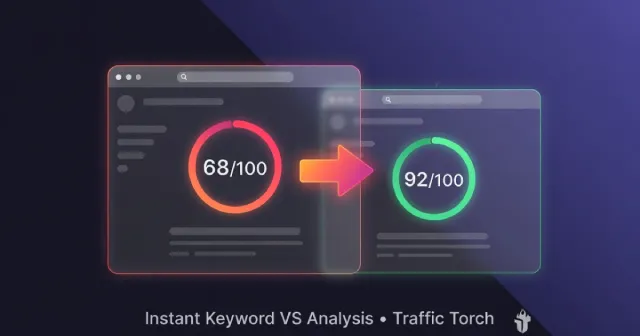
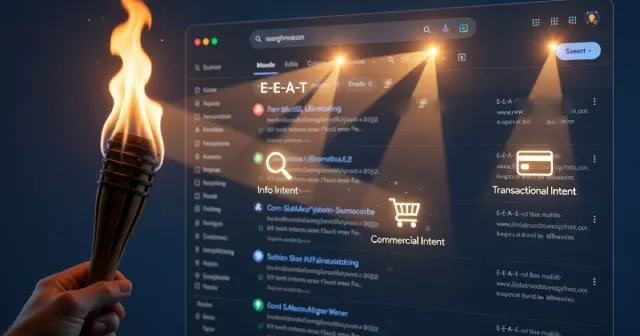
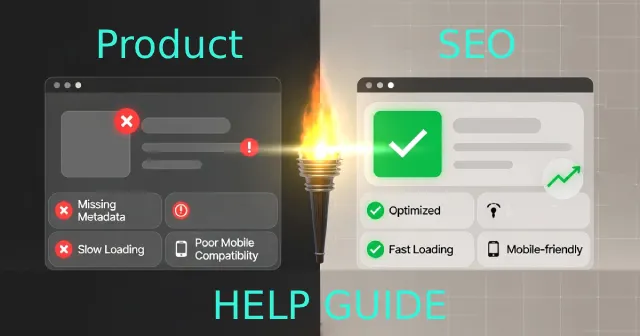
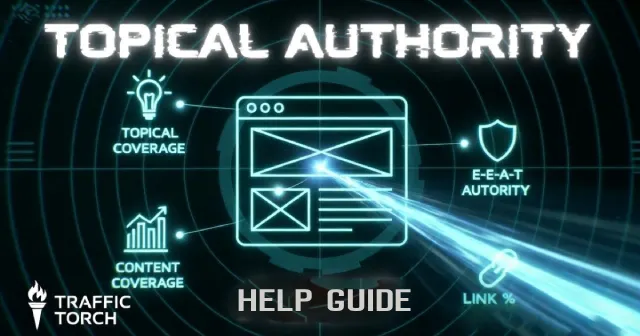
Struggling to rank higher in search results? Modern keyword optimization is not about density, it is about intent alignment and semantic coverage. This guide explains the nine core on-page factors Traffic Torch audits: what each is, how it is tested, and why it matters for SEO and UX. You will learn how to combine classic on-page placement with two AI semantic layers — page-level analysis of intent match, entity coverage, AEO answerability, and E-E-A-T, plus per-placement Semantic Coverage grading that decides whether each on-page element expresses the keyword as exact, variant, partial or absent.
Introduction to Keyword Optimization: From Stuffing to Semantics
Keyword optimization started in the 1990s with early search engines like AltaVista, where stuffing keywords could game rankings. Google's PageRank in 1998 shifted focus to natural relevance.
BERT (2019), MUM (2021), Helpful Content updates (2022–2025), and AI Overviews (2024–2026) changed the game again. Today, search engines evaluate meaning — not repetition. Density charts and exact-match targets are gone. What matters now is whether your page aligns with user intent, covers the right entities, and answers the questions a searcher actually has. And critically: a placement that expresses the same service or topic with different words now counts — so semantic variants matter as much as exact matches.
This guide covers nine core modules, drawing from Google's SEO Starter Guide and studies like Ahrefs' ranking factors research.
See your SEO Keywords score in seconds.
Run an instant hybrid audit with Traffic Torch.
Test Your webpage SEO Keywords →Frequently Asked Questions
What is the ideal keyword placement strategy in 2026? ▼
Focus on natural integration plus semantic coverage. Put the primary keyword in the meta title (front-loaded), H1, first 100–150 words, at least one image alt, and 1–2 strategic internal anchors. But do not stop at placement — modern search engines evaluate whether you cover the entities, subtopics, and questions a top-ranking page would, and whether each placement expresses the same intent as the keyword, even with different words. Traffic Torch's audit scores exactly this across three layers: deterministic placement, page-level AI semantics (intent, entity coverage, AEO answerability, E-E-A-T), and per-placement Semantic Coverage (exact, variant, partial or absent).
How important is keyword density today? ▼
Keyword density is no longer a useful metric. Google's BERT and MUM models evaluate meaning, not repetition, and AI Overviews pull from semantically complete answers rather than pages that hit a specific percentage. Traffic Torch removed the density check entirely and replaced it with content depth, readability, a page-level AI semantic coverage score, and a per-placement Semantic Coverage audit that grades each on-page element by intent match. Write for humans, express the same service or topic in natural language, and cover the subject fully — that is what correlates with rankings in 2026.
Does schema markup still help rankings in 2026? ▼
Indirectly — yes. Schema does not directly boost core rankings, but it unlocks rich results (stars, FAQs, carousels) that dramatically increase CTR and visibility in zero-click SERPs and AI-generated answers. Article, FAQPage, HowTo, Product, and BreadcrumbList schemas are the most impactful for blog and content pages. Traffic Torch validates that your JSON-LD parses correctly and detects the schema types present.
Should I put the keyword in the URL? ▼
Yes — if it is natural and does not require breaking existing URLs. A clean, keyword-containing URL (e.g. /best-seo-tools-2026) improves CTR from SERPs and reinforces topical relevance. If you change an existing URL, use 301 redirects and update internal links and sitemap. Traffic Torch also checks that URLs use lowercase, hyphens, and avoid query parameters.
How does Traffic Torch's AI semantic audit work? ▼
Traffic Torch runs a three-layer audit. The first layer (55 points) is deterministic — hard facts about keyword placement, meta lengths, headings, image alts, internal anchors, URL, schema, technical hygiene, content depth and readability. The second layer (15 points) sends a text excerpt of your page to a Cloudflare Workers AI endpoint that predicts search intent, generates the entities and questions a top-ranking page would cover, and scores your page on entity coverage, AEO answerability, semantic coverage, and E-E-A-T signals (author, citation, experience, trust). The third layer (30 points) is the Semantic Coverage audit — the same AI classifies every on-page placement (title, meta description, H1, H2s, image alts, internal anchors, URL slug) as exact, variant, partial or absent, then weights them by placement importance (title and H1 count most; image alts and anchors least). Results are cached by content hash, so re-running an unchanged page is instant, while any page edit produces a fresh analysis.
How often should I re-audit my pages? ▼
Every time you significantly update content, after major Google core updates, or quarterly for high-traffic pages. Use Traffic Torch's instant audit to track progress after fixes — most noticeable CTR and position changes appear within 7–30 days post-reindexing.
Meta Title & Description
Including your target keyword naturally in the page title (30–60 characters) and meta description (120–160 characters) is still one of the strongest on-page SEO signals in 2026. Google continues to use the title for ranking relevance and displays both elements in results. Optimized titles and descriptions can increase click-through rates by 20–40% and help pages rank higher for exact-match and related queries.
What It Is & Its Evolution?
The meta title (the <title> tag) is the clickable blue headline users see in Google search results. The meta description is the short summary paragraph displayed below it.
These elements have been fundamental since the earliest search engines. In 1993–1996 they were heavily abused (keyword stuffing), but after Google's rise and multiple algorithm updates — especially the 2009 title & snippet rewrite shift and Helpful Content updates (2022–2025) — the focus moved to user-first relevance and natural language.
Today they serve three masters:
- Search engines — primary relevance signal for the query
- Users — decide whether to click based on title + description
- AI overviews & voice search — often pull directly from optimized snippets
How Traffic Torch Tests It?
Our tool fetches your live page through a privacy-respecting proxy, parses the real DOM, and performs the following checks:
-
✓
Word-boundary keyword match: Detects the keyword only when it appears as a complete phrase, not as part of another word. This eliminates false positives that older substring matching produced.
-
✓
Prominence check: Awards extra credit when the keyword appears near the start of the title (position matters more than repetition).
-
✓
Length awareness: Scores titles in the 30–60 character range as optimal and flags titles outside that window.
-
⚠
CTR signal check: Detects action-oriented words (learn, discover, get, try, see, explore) that improve click-through rates.
Methodology inspired by Google's official title link documentation and web.dev best practices.
Why It Matters for SEO & User Experience?
SEO Impact
- Primary ranking signal: Keyword in title remains one of the top 3 on-page factors (Ahrefs, Semrush studies 2024–2025).
- Exact & semantic match: Helps rank for long-tail and voice queries.
- Rich results eligibility: Clean titles feed sitelinks, featured snippets, and AI overviews.
UX & Business Impact
- CTR lift: 20–40% higher clicks when keyword + benefit appear early.
- Lower bounce rate: Sets accurate expectations → better user satisfaction.
- Brand trust: Professional, keyword-relevant snippets look more authoritative.
H1 & Headings
Placing your primary target keyword naturally in the H1 heading remains a meaningful on-page SEO signal in 2026. Google still weighs the H1 — and, to a lesser extent, H2–H6 — for understanding page topic and hierarchy. A keyword-relevant H1 helps pages rank higher, appear in featured snippets more often, and improves user orientation, especially on mobile.
What It Is & Its Evolution?
The H1 heading is the main title of your page content — usually the largest, most prominent text block right below the navigation. Secondary headings (H2, H3, etc.) break content into logical sections.
Headings originated in HTML 1.0 (1991–1993) purely for document structure. They became a ranking factor with Google's early algorithms (2000s), gained semantic importance after the 2011 Panda update, and became even more critical with:
- 2018–2019 BERT & MUM updates (better understanding of intent & hierarchy).
- 2021–2025 Helpful Content & Core Web Vitals emphasis on scannability.
- 2024–2026 AI Overviews that frequently pull answers directly from well-structured headings.
Today headings serve three key roles:
- SEO: Strong topical relevance signal after title.
- UX: Makes long-form content scannable in under 4 seconds.
- Accessibility: Screen readers use heading levels to navigate.
How Traffic Torch Tests It?
The tool performs a clean, client-side DOM analysis of your live page:
-
✓
Single H1 check: Verifies exactly one <h1> exists. Multiple H1s are flagged as a hierarchy issue.
-
✓
Keyword match in H1: Word-boundary phrase matching for the target keyword.
-
✓
H2 reinforcement: Checks whether at least one H2 contains the keyword or a close semantic variant to reinforce topical depth.
-
⚠
Visual preview: Shows H1–H3 hierarchy as it appears to users and crawlers.
Aligned with Google's heading guidance and web.dev accessibility recommendations.
Why It Matters for SEO & User Experience in 2026?
SEO Impact
- Top on-page factor: H1 keyword match correlates strongly with higher rankings (large-scale 2024–2025 studies).
- Featured snippets & AI overviews: Many answers pulled directly from H2/H3 subheadings.
- Topical authority: Clear hierarchy helps Google map entity relationships.
UX & Business Impact
- Scannability: 80%+ of users scan before reading; good headings reduce bounce by 20–35%.
- Dwell time boost: Logical structure keeps visitors longer → stronger behavioural signals.
- Accessibility win: Proper heading levels improve WCAG compliance and screen-reader UX.
Content & Readability
Content depth (roughly 800+ words for competitive queries), short sentences, and clear paragraph structure still correlate strongly with higher rankings — but keyword density does not. Modern search engines use BERT and MUM to evaluate meaning, not repetition. Traffic Torch no longer calculates density at all; instead it measures word count, average sentence length, and paragraph structure, and hands the semantic coverage question to the two AI layers (AI Semantic Audit and Semantic Coverage).
What It Is & Why Density Was Dropped
For over a decade, SEOs chased a "1–2% keyword density" target. That metric is dead. Google has repeatedly confirmed that it evaluates semantic meaning, intent satisfaction, and topical completeness — not how many times you repeat a phrase. When you chase a density percentage, you either under-write (missing subtopics) or over-write (unnatural repetition that hurts readability).
What actually correlates with rankings now:
- Depth: Pages that fully answer the query tend to be longer than thin pages — but length is a byproduct of completeness, not a target.
- Readability: Short sentences and paragraphs improve dwell time, mobile experience, and screen-reader access.
- Semantic coverage: Whether you cover the entities, subtopics, and questions a top-ranking result covers (scored by the AI Semantic Audit module) and whether each placement expresses the keyword's topic (scored by the Semantic Coverage module).
How Traffic Torch Tests It?
The tool uses a clean, client-side content extraction pipeline. No keyword density calculation is performed.
-
✓
Main content extraction: Removes nav, footer, sidebars, scripts, styles, ads, popups, cookie banners.
-
✓
Word count: Splits cleaned text into words (filtering short tokens), counts total meaningful words.
-
✓
Average sentence length: Word count divided by sentence count. Under 25 words is scored as readable; under 20 is optimal.
-
✓
Paragraph count: Fewer than 5 paragraphs on a long page is flagged as an engagement issue.
-
⚠
Depth scoring: Points scale linearly from 0 to 800+ words, then plateau. Depth above 1,500 words earns full credit.
Extraction logic follows Google's Helpful Content guidelines and readability best practices from web.dev.
Why It Matters for SEO & User Experience?
SEO Impact
- Top ranking correlate: Pages that fully cover the topic consistently outrank thin content (2024–2025 Backlinko, Semrush, Ahrefs studies).
- AI Overview dominance: Comprehensive, well-structured answers are far more likely to be quoted.
- Behavioural signals: Longer dwell time and lower pogo-sticking from satisfying content.
UX & Business Impact
- User satisfaction: Complete answers reduce bounce rate by 25–45%.
- Authority & trust: In-depth content positions you as the go-to expert.
- Conversion lift: Readers who find value stay longer → higher chance of sign-ups, purchases, and shares.
Check out your SEO Keywords Analysis.
Run an instant hybrid audit with Traffic Torch.
SEO Keywords Audit Tool →Image Alt Text
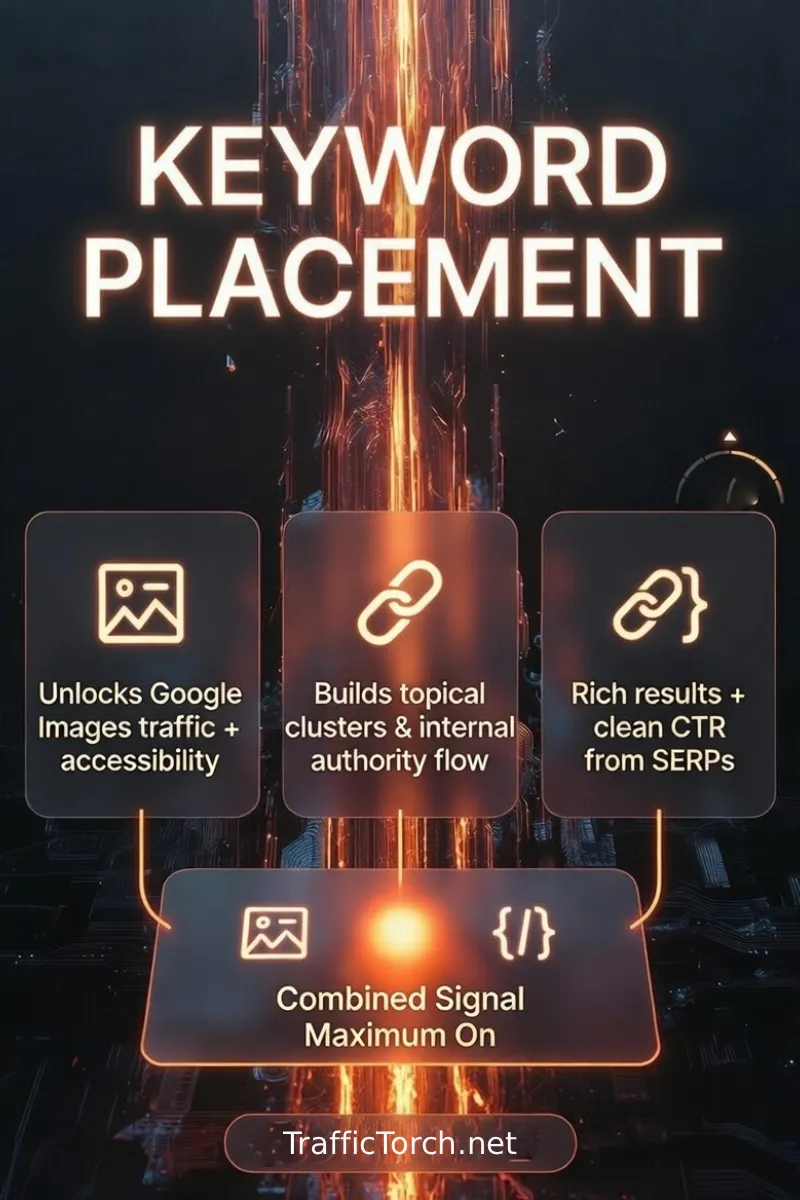
Adding descriptive, keyword-relevant alt text to your important images remains a meaningful ranking factor in 2026, especially for Google Images traffic, accessibility compliance, and overall page topical relevance. Alt text is no longer a massive ranking booster like it was pre-2018, but well-optimized alts can drive 10–30% additional organic traffic from image search and help pages appear in multimodal AI results.
What Is It?
The alt attribute (alternative text) is a short description added to every <img> tag. It tells search engines and screen readers what the image shows when the image itself cannot be displayed or seen.
Alt text became mandatory for accessibility with WCAG 1.0 in 1999. Google started treating it as an image SEO signal around 2007–2008 (post-Universal Search launch). Key evolution milestones:
- 2010–2015: Alt text with exact keywords was heavily weighted for image rankings.
- 2018–2020: Google shifted emphasis to visual understanding via neural networks (less keyword-stuffing tolerance).
- 2022–2026: Helpful Content + multimodal AI updates → descriptive, natural alt text now supports both accessibility and contextual relevance in Google Lens, AI Overviews, and image packs.
Today alt text serves three primary purposes:
- Accessibility: WCAG 2.2 AA compliance (screen readers).
- SEO: Contextual signal + Google Images traffic.
- UX fallback: Shows when images fail to load (slow connections, data-saver mode).
How Traffic Torch Tests?
The tool performs a fast, client-side scan of your live page:
-
✓
Total image count: Identifies all
<img>elements on the page. -
✓
Keyword presence: Checks alt attributes for word-boundary phrase matches.
-
✓
Alt coverage ratio: Scores the percentage of images with any alt attribute, then adds bonus points for keyword-relevant alts.
-
⚠
Missing alt warning: Flags images without alt or with empty alt="" on meaningful images.
Testing follows Google Images SEO best practices and W3C/WAI alt text guidance.
Why It Matters for SEO & User Experience?
SEO Impact
- Google Images traffic: Optimized alts can drive 10–30% extra organic visits (especially visual niches).
- Page relevance signal: Helps Google understand image context in multimodal search.
- AI Overview inclusion: Descriptive alts improve chances of images being referenced.
UX & Business Impact
- Accessibility compliance: WCAG requirement → avoids legal risk & improves inclusivity.
- Slow-connection fallback: Meaningful alts shown when images don't load (huge in mobile-first markets).
- Trust & professionalism: Polished sites with proper alts appear more credible.
Anchor Text
Using your target keyword (or close natural variations) in internal anchor text remains an important on-page and site architecture signal in 2026. Descriptive, keyword-relevant anchor text helps Google understand page relationships, strengthens topical clusters, and improves crawl efficiency. Well-optimized internal links can lift site-wide authority flow and user navigation, indirectly supporting higher rankings.
What It Is & Its Evolution
Anchor text is the visible, clickable text inside an <a> tag that users see and click. For internal links (same domain), it tells both users and search engines what the linked page is about.
Anchor text became a core ranking factor with Google's original PageRank algorithm (1998). It was heavily abused in the 2000s (exact-match over-optimization), leading to major crackdowns:
- 2012 Penguin update → penalized aggressive exact-match anchor text.
- 2016–2019 → shift toward natural, branded, and partial-match anchors.
- 2022–2026 → Helpful Content + entity-based ranking → focus on semantic relevance, topical clusters, and user-first linking.
Modern philosophy: internal anchor text should be descriptive, natural, and helpful, ideally containing the target keyword or a strong semantic variant when contextually appropriate.
How Traffic Torch Tests It?
The tool scans your live page DOM for internal linking patterns:
-
✓
Internal link detection: Identifies
<a>tags where the href resolves to the same hostname as the audited page. External links, mailto:, tel:, and javascript: are excluded. -
✓
Anchor text analysis: Checks visible text for word-boundary phrase matches against the target keyword.
-
✓
Volume scoring: Full points for at least 6 internal links with at least one using the keyword as anchor.
-
⚠
Zero-match warning: Flags when no internal anchors use the keyword (missed opportunity for relevance reinforcement).
Methodology aligns with Google's internal linking guidance and Moz's internal linking best practices.
Why It Matters for SEO & User Experience in 2026?
SEO Impact
- Topical cluster reinforcement: Keyword anchors help Google map site architecture and entity relationships.
- Link equity distribution: Passes contextual relevance signals between related pages.
- Crawl efficiency: Descriptive anchors guide crawlers to important content faster.
UX & Business Impact
- Intuitive navigation: Clear anchor text reduces clicks to wrong pages → lower bounce rate.
- Dwell time improvement: Users follow relevant links → stronger behavioural ranking signals.
- Conversion path support: Strategic internal linking guides visitors toward key actions.
URL & Schema Markup
Including your target keyword in a clean, readable URL (hyphen-separated) and implementing structured data (JSON-LD schema) are still high-impact on-page signals in 2026. Keyword-rich URLs improve perceived relevance and CTR from SERPs, while schema enables rich results (stars, FAQs, carousels), boosting visibility by 20–50% in many niches. Traffic Torch checks both to help you capture these easy wins.
What It Is & Its Evolution?
The URL is the unique web address of your page. Schema markup (usually JSON-LD) is structured data embedded in the <head> or <body> that helps search engines understand content type, entities, ratings, FAQs, products, articles, and more.
Clean URLs became important with Google's early indexing (2000s). Keyword inclusion in URLs was a strong signal until ~2012. Schema.org launched in 2011 (joint effort by Google, Bing, Yahoo), and rich snippets exploded after 2015–2016.
Key modern milestones:
- 2017–2020: Mobile-first indexing → short, readable URLs became even more critical.
- 2021–2023: Passage Indexing & MUM → schema helps identify entity-rich passages.
- 2024–2026: AI Overviews, rich results expansion, zero-click SERPs → schema is now essential for visibility in carousels, knowledge panels, and generative answers.
Best practice today: keyword-focused slugs + relevant schema (Article, FAQPage, HowTo, Product, LocalBusiness, etc.) for maximum SERP real estate.
How Traffic Torch Tests?
The tool evaluates both signals with lightweight, client-side checks:
-
✓
URL keyword match: Splits the URL by non-alphanumeric characters, checks whether ≥60% of the keyword's words appear in the URL path.
-
✓
URL cleanliness: Flags uppercase letters, underscores, and query parameters.
-
✓
Canonical tag: Checks for a valid <link rel="canonical"> in the <head>.
-
✓
Schema parsing: Every <script type="application/ld+json"> block is parsed with JSON.parse. Valid blocks earn points; broken JSON is flagged.
-
⚠
Schema type detection: Extracts @type values from the parsed graph and gives bonus points for known high-value types (Article, FAQPage, HowTo, Product, Organization, BreadcrumbList).
Aligned with Google's structured data intro.
Why It Matters for SEO and UX in 2026 and Beyond?
SEO Impact
- CTR from SERPs: Keyword in URL + rich snippets = 20–50% higher click-through in many verticals.
- Rich results eligibility: Schema unlocks stars, FAQs, how-tos, carousels, knowledge panels.
- Entity & topical clarity: Clean URLs + schema reinforce page intent for AI-driven ranking.
UX & Business Impact
- Trust & expectation: Descriptive URLs reduce hesitation before clicking.
- Enhanced SERP visibility: Rich results take more screen space → higher brand exposure.
- Voice & mobile search: Schema helps appear in spoken answers and mobile carousels.
Technical SEO
Four technical signals underpin every other on-page optimization: html lang, viewport, robots meta, and Open Graph tags. If any of these are missing or misconfigured, your best content can still fail to render on mobile, fail to be indexed, or fail to attract clicks when shared.
What It Is
- html lang: The
lang="en"attribute on the <html> tag. Tells screen readers and search engines the page language. - Viewport: The
<meta name="viewport" content="width=device-width, initial-scale=1">tag. Makes the page render correctly on mobile. - Robots meta: The
<meta name="robots">directive. Controls whether search engines index and follow the page. - Open Graph tags:
og:titleandog:description. Control how the page appears when shared on social media and in messaging apps.
How Traffic Torch Tests?
-
✓
lang attribute: Reads the <html lang> value. Pass if non-empty.
-
✓
Viewport meta: Pass if the content string includes
width=device-width. -
✓
Robots meta: Pass unless
noindexis present. -
✓
Open Graph: Pass if both
og:titleandog:descriptionare present.
Why It Matters
SEO Impact
- Mobile-first indexing: Missing viewport breaks mobile rendering, which is a primary ranking factor.
- Accidental noindex: Blocks indexing entirely — highest-severity technical issue.
- Language detection: Missing lang hurts international targeting and accessibility.
UX & Business Impact
- Social sharing: Missing OG tags cause ugly, low-CTR previews.
- Accessibility: Screen readers rely on lang to select the right pronunciation.
- Mobile experience: Without viewport, users must pinch and zoom — immediate bounce.
AI Semantic Audit
The AI Semantic Audit is the first of two AI layers and the module that replaces the old keyword density check. It evaluates your page the way modern search engines do: by search intent, entity coverage, AEO answerability, and E-E-A-T signals. It runs on Cloudflare Workers AI and contributes 15 out of 100 points to your overall score, alongside 55 points from the deterministic modules and 30 points from the companion Semantic Coverage layer.
What It Scores
- Intent: Predicts the search intent behind your keyword (informational, commercial, transactional, navigational) and assesses whether your page format matches it.
- Entity coverage: Generates the entities a top-ranking page would cover and measures how many appear on your page.
- AEO answerability: Lists the questions a searcher would have and scores how many your content directly answers.
- Semantic coverage: An overall judgment of topical completeness at the page level (distinct from the per-placement Semantic Coverage module described below).
- E-E-A-T signals: Author, citation, experience, and trust signals visible in the excerpt.
How Traffic Torch Tests It?
The deterministic layer extracts a compact text summary of your page (title, meta description, H1, headings, image alts, schema types, and the first ~3,500 characters of body content) and sends it to a Cloudflare Workers AI endpoint running GLM-4.7-Flash. The model returns a structured JSON response with intent, entities, questions, E-E-A-T scores, and an overall semantic score.
Results are cached by a SHA-256 hash of the full input, so:
- Re-running the same audit is instant (cache hit).
- Any page edit — title, heading, body, alt, schema — produces a fresh AI call.
- No stale results, ever.
Model: @cf/zai-org/glm-4.7-flash running on Cloudflare Workers AI. Output is validated and normalized before scoring to prevent malformed responses from affecting results.
Why It Matters for SEO & User Experience in 2026?
SEO Impact
- Matches how modern search works: Google and AI search engines evaluate intent and entity coverage, not keyword repetition.
- Predicts AI Overview inclusion: Pages that fully answer intent are far more likely to be quoted.
- Topical authority: Entity coverage directly influences how Google maps your site's expertise.
UX & Business Impact
- Content planning: The "missing entities" and "unanswered questions" lists become a content outline for future updates.
- E-E-A-T improvement: Concrete, actionable signals to add (author bio, citations, original data).
- Objective quality signal: A single 0–100 score for "did we cover the topic?" — no more guessing.
Semantic Coverage
Semantic Coverage is the second AI layer. It grades every on-page placement individually — not as a string match, but as a relevance match against the intent and topic of your keyword. It contributes 30 out of 100 points and answers the question that exact-match checks cannot: does this title, heading or alt text express the same service or topic, even when it uses different words?
What It Scores
Every placement is classified into one of four verdicts:
- Exact (100 pts): The keyword appears verbatim (case-insensitive, ignoring punctuation).
- Variant (80 pts): Different words, but the same service, topic or intent — e.g. "Syd Plumbing Services" for the keyword "plumber sydney".
- Partial (30 pts): Some word overlap or an adjacent concept, but not the same service or topic — e.g. a location name alone.
- Absent (0 pts): No meaningful connection to the keyword.
Each verdict is then weighted by placement importance:
-
★
Title (weight 3) and H1 (weight 3) — the highest-impact placements.
-
★
Meta description (weight 2) and URL slug (weight 2) — strong secondary signals.
-
★
H2 headings (weight 1 each) — reinforcement signals.
-
★
Image alts and internal anchors (weight 0.5 each) — smallest contribution per item, but still counted.
The result is a weighted 0–100 coverage score that reflects how well your page's placements express the keyword's topic — not just how many times the exact string appears.
How Traffic Torch Tests It?
After the deterministic layer has extracted your placements (title, meta description, H1, up to five H2s, up to five image alts, up to five internal anchors, and the URL slug), they are sent together with the target keyword to the same Cloudflare Workers AI endpoint in a dedicated mode. The model receives worked examples across different industries (local services, food, wellness) that teach it to recognise semantic variants rather than only exact matches, then returns a verdict and short reason for each placement.
Key operational details:
- Each placement is scored individually, so you can see exactly which title, H1, H2, alt or anchor is pulling your score down.
- Verdicts are weighted by placement, so a variant in the title counts more than a variant in an image alt.
- Results are cached by a SHA-256 hash of the keyword + placements, so identical audits are instant.
- Any change to the target keyword or a placement triggers a fresh analysis.
Model: @cf/zai-org/glm-4.7-flash with a low temperature (0.25) for deterministic classification. Verdicts are normalized to the four-value vocabulary to prevent malformed output from affecting scores.
Why It Matters for SEO & User Experience in 2026?
SEO Impact
- Rewards natural writing: Variants count, so you don't have to repeat the exact keyword to score well.
- Catches false negatives: A page can be perfectly on-topic without ever using the exact keyword phrase — this layer recognises that.
- Surfaces weak placements: Shows you exactly which title, heading or anchor is expressing the wrong topic.
UX & Business Impact
- Encourages user-first writing: You stop chasing exact-match strings and start writing naturally.
- Reduces over-optimization risk: Detecting variants as valid removes the temptation to stuff the exact keyword.
- Actionable placement list: Each verdict is paired with a reason, so the fix is obvious.
Master On-Page Keyword Optimization in 2026
Keyword optimization is no longer about stuffing — it is about creating relevance, satisfying user intent, and delivering exceptional experiences. The nine modules covered here represent the highest-leverage on-page factors still driving rankings today: Meta Title & Description, H1 & Headings, Content & Readability, Image Alts, Anchor Text, URL & Schema, Technical SEO, the AI Semantic Audit, and the per-placement Semantic Coverage layer.
Key Takeaways
- Natural & user-first: Prioritize clarity and intent match over exact-match density.
- Semantic depth wins: Cover the entities, subtopics, and questions a top-ranking page covers.
- Variants count: A placement that expresses the same service or topic scores even without the exact keyword string.
- Three-layer scoring: 55 deterministic points + 15 AI semantic points + 30 Semantic Coverage points = a defensible 0–100 score.
- Ongoing process: Audit regularly, especially after content updates or algorithm shifts.
Next Steps
- Run a free audit on your most important page.
- Implement the top-priority fixes shown in your report.
- Review the Semantic Coverage panel — check for any placement marked partial or absent and rewrite it to express the same intent as the keyword.
- Use the AI module's "missing entities" and "unanswered questions" lists as a content roadmap.
- Monitor changes in Google Search Console (CTR, impressions, position).
- Re-audit after 2–4 weeks to track progress.
Related reading:
Keyword Competition Tutorial • AI Search Optimization Guide • Traffic Torch SEO Help Guides
Test your website SEO Keywords.
Run an instant hybrid audit on Traffic Torch.
Free SEO Keywords analysis Tool →