
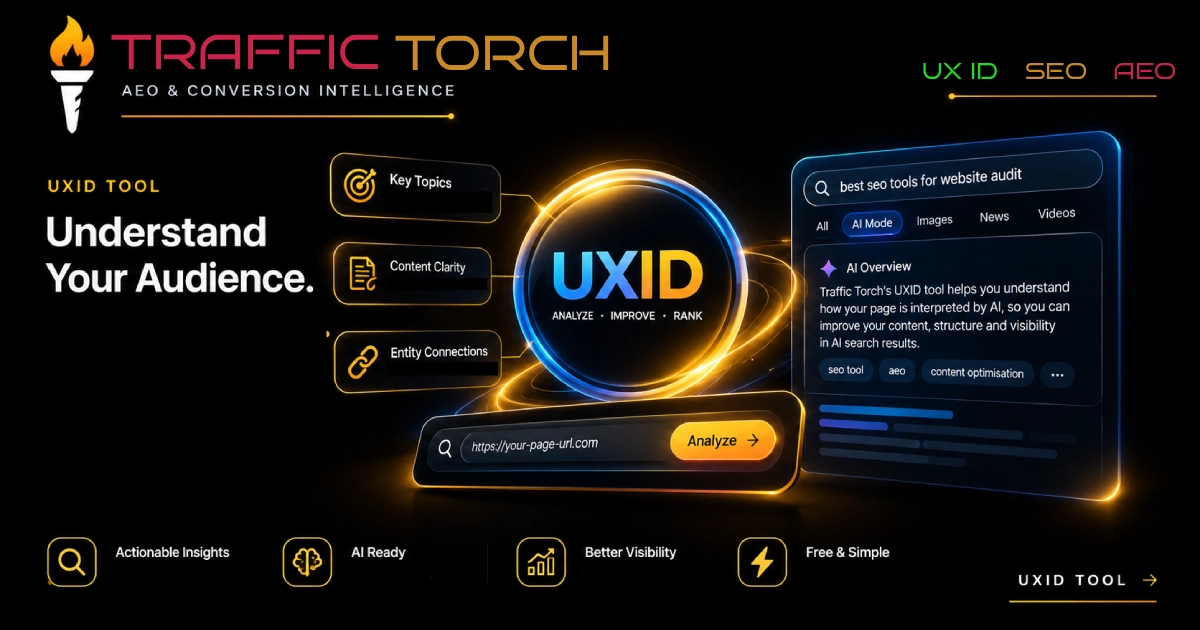
UXID Help Guide – UX Incentive Design Signals Explained
The 15 signals behind the UXID score, how Both / SEO / AEO modes weight them, and how to fix what matters most.
UXID is Traffic Torch's UX incentive design audit. It measures the concrete signals that give a visitor a reason to act — and a reason to trust you. Every signal is extracted deterministically from the page HTML with pure DOM and regex rules. There is no AI in the score itself; the optional AI panel only suggests fixes.
This guide is the reference for what each signal means, what scores well, and how to fix the ones that don't. Every section in this guide is a direct anchor target from a metric card in the tool — click any metric in a UXID audit and it lands you here.
Ready to score a page?
Paste any URL and get a Both / SEO / AEO score in one scan.
Free • Deterministic • No data stored.
1. What is UXID?
UXID stands for User Experience Incentive Design. It is the sibling tool to Quit Risk: where Quit Risk measures what makes visitors leave, UXID measures what makes them act.
A page can look beautiful and still fail to convert. Usually that's not a visual problem — it's an incentive problem. The button says "Submit" instead of "Start free trial". The opening paragraph talks about the company instead of the visitor. The testimonials sit three sections below the CTA. There is no urgency because the deadline is vague. There is no reciprocity because nothing is offered for free.
UXID scores 15 concrete signals across four bands — Core action, Trust, Commitment, and AEO — and combines them into a 0–100 score with a mode-specific weighting.
2. How the score works
Each of the 15 signals returns a score from 0–100, or not detected if the page doesn't have the signal at all. Signals that are not detected are excluded from the weighted average — they don't count as failures.
The final score is a weighted average of the detected signals, using a mode-specific weight table:
| Mode | What it emphasises | Best for |
|---|---|---|
| Both | Averages all 15 signals equally (AEO signals slightly lower). | Overall incentive health. |
| SEO | Weights CTA specificity, action-oriented headings, and value-first framing higher. | Organic click-through and dwell time. |
| AEO | Weights lists, sourced stats, definitional clarity, FAQ structure, and structured data higher. | AI citation-worthiness (Perplexity, ChatGPT Search, Gemini, Grok). |
Switching modes in the tool re-weights the score instantly using already-extracted signals — no re-fetch.
3. Core action signals
The four signals that most directly drive "did the visitor do the thing?". These have the highest weight in SEO mode.
3.1 CTA specificity
Why it matters: The button label is the last thing a visitor reads before committing. It answers one narrow question: what happens in the next three seconds, and what do I get for it? Vague labels ("Submit", "Learn More") force the visitor to imagine the answer, and people imagine badly — a form, a sales call, a mailing list. Specific labels ("Download the 50-Page Guide", "Start my 14-day trial") close that gap. Across hundreds of A/B tests, specific CTA copy outperforms vague copy by 15–35% because it prices the risk accurately[reference:0]. First-person framing ("Start my trial" instead of "Start your trial") adds another 25–35% lift by putting the visitor in their own voice[reference:1]. The button's visual design matters only as a threshold: it must be the highest-contrast element in its immediate context, but once that threshold is met, copy does the work[reference:2].
UXID scores every visible a, button, input[type=submit], and [role=button] against a deterministic rubric:
- Verb strength — strong verbs (start, get, claim, unlock, discover) score +30; good verbs (try, begin, launch, create, download) score +25; moderate +15; weak (submit, click, continue) +5; no verb −10.
- Benefit words — free, instant, today, unlimited, exclusive, no credit card → +12.
- Specificity — numbers, timeframes (in 5 minutes, 14-day) → +10.
- Urgency — now, today, limited → +8.
- Length — 2–5 words optimal (+5); 8+ words penalised (−10).
- Format —
<button>or button-style class → +5.
Fixes: Replace "Submit" with "Start free trial". Replace "Click here" with "Download the checklist". Add specificity only when true (don't invent timeframes). Keep length 2–5 words. The strongest CTAs name the action, the outcome, and (optionally) the constraint.
3.2 CTA visibility
Structural proxy for whether the primary CTA is above the fold, minimum 44px tall, and high-contrast. Because UXID parses static HTML, this is a best-effort estimate — the tool labels this limitation clearly on the hero card.
Fixes: Put the primary CTA inside the first <section> or before the first <h2>. Ensure min-height ≥ 44px. Use a high-contrast button style. If you need true rendered position, pair with Quit Risk.
3.3 Value-first framing
Reads the first 150 words of the main content and looks for benefit-first phrasing: you get, so you can, helps you, save time, grow traffic, in 5 minutes, without [X], and related patterns. Feature-first or company-first openings score low.
Fixes: Open with the benefit. "Traffic Torch audits SEO, UX, and AEO in one pass — so you can fix what matters without stitching tools together." Name the outcome in the first sentence, then explain how.
3.4 Action-oriented headings
Scans all H1 and H2 headings. Action verbs at the start (Start, Discover, Get, Build, Fix) score higher than passive/about labels (About us, Our story, Welcome).
Fixes: Convert "About our company" → "Build a faster site in four steps". Convert "Our story" → "See how we help teams ship faster". Passive headings are not always wrong — but they should be the minority.
4. Trust signals
The signals that tell the visitor "this is real, this is safe, and other people trust it too."
4.1 Social proof placement
Why it matters: Social proof is not a section on a page. It is a moment in a decision. Research from the Journal of Consumer Psychology found that proof effectiveness depends entirely on timing: when a visitor is still figuring out what the product is, proof creates cognitive noise. When they are evaluating whether to act, proof reduces uncertainty[reference:3]. Moving three testimonials next to the primary CTA lifted clicks by roughly 20% compared with parking them in a separate section[reference:4]. Nielsen Norman Group research on trust indicators confirms that proximity matters: proof elements on the same visual unit as the CTA have higher influence than proof elements in adjacent sections[reference:5]. The format of the proof also matters. A rating with a named platform ("★★★★★ 4.8 from 2,400 reviews") is more credible than a generic quote. A customer count with specificity ("Trusted by 2,300+ agencies") is more credible than a round number ("Trusted by thousands").
UXID counts testimonials, ratings, client logos, and review schema — and measures proximity to the primary CTA. Proof placed within 300px of a CTA scores higher than proof buried three sections below. Metadata signals (schema sameAs, citation, author, Organization) count too, because AI engines weight them heavily.
Fixes: Move the best 3 testimonials near the primary CTA. Add Review or AggregateRating schema. Include a name, company, and result in each testimonial. For AEO, add sameAs links to authoritative profiles (Wikidata, ORCID, LinkedIn, GitHub).
4.2 Trust anchors
Counts distinct trust patterns in the main content: money-back, guarantee, refund, cancel anytime, no credit card, secure, privacy, GDPR, SOC 2, HIPAA, warranty, risk-free, encrypted, no tracking, no data selling, transparent, open source.
Fixes: Add concrete guarantees ("30-day money-back"). Say what you do not do ("We don't sell your data"). Show security details on the checkout or signup page. Place trust phrases near the CTA — a guarantee in the footer converts worse than the same guarantee above the button.
4.3 Ethical urgency
Detects countdown widgets, deadline phrases (ends today, last chance, limited time, only X left), and specific dates. Classifies as Ethical (specific date or event), Review (generic deadline phrase), or Flagged (countdown with no real deadline). Does not auto-penalise — the badge shows what was found, not a score.
Fixes: Only use urgency when it's real. "Sale ends March 15" scores higher than "Limited time only". If you use a countdown, wire it to a real deadline. If you don't have urgency, that's fine — the score is neutral (60), not a failure.
5. Commitment signals
The signals that measure whether the ask matches the visitor's current level of commitment — and whether the friction is proportional to the value.
5.1 Friction-to-value ratio
Counts visible form fields and divides by the number of value propositions (list items, benefit sentences, feature cards). Lower ratio = higher score. Cap at 10 fields / 10 props to prevent outliers from dominating.
Fixes: Reduce fields to the minimum needed. Every extra field drops conversion by an average of 3–5%. Add value props near the form to justify the ask. If a form asks for a phone number, it must return obvious value in return.
5.2 Micro-commitment ladder
Classifies CTAs into three levels: Low (newsletter, free guide, download), Medium (free tool, trial, calculator, sample), High (purchase, demo, contact sales). Pages with 2+ distinct levels score better — because they give visitors multiple entry points.
Fixes: Add a low-commitment entry point if your only CTA is high-commitment. "Get the free guide" is easier to say yes to than "Book a demo". Then escalate: guide → trial → purchase.
5.3 Reciprocity
Why it matters: Robert Cialdini's research on reciprocity demonstrates that giving something of genuine value before requesting action creates a psychological obligation that improves response rates[reference:6]. A classic field experiment found that restaurant servers who gave an unexpected second mint with the bill saw tips rise 23% compared with no mint. The key is that the gift must feel personal and unexpected, not transactional. In digital marketing, this translates to free tools, ungated content, and actionable resources that solve a real problem without requiring an email address first. Brands that invest in genuine reciprocity report 30–45% higher engagement rates on subsequent conversion requests compared with direct promotional approaches[reference:7]. A lead magnet that feels like bait — "Download our guide!" followed by a 10-field form — triggers skepticism, not obligation.
UXID scans the main content for free-value patterns: free tool, free audit, free template, free sample, free calculator, free checklist, download free, try free, free plan, free tier. Also counts <a download> links.
Fixes: Offer something free before you ask for the sale. A free audit, template, calculator, or sample chapter. Reciprocity is one of the strongest conversion drivers in behavioural economics — the recipient feels an obligation to return the favour.
6. AEO signals
The signals that matter specifically for AI citation-worthiness. These have the highest weight in AEO mode.
6.1 List presence
Why it matters: AI engines assemble answers from fragments. A list is already fragmented — discrete, parallel, liftable. Prose has to be taken apart first. In a 2026 analysis of 18 pages that AI assistants actually cited in a financial category, 89% contained a list[reference:8]. That was the only near-universal signal. Structured data appeared on 67% of cited pages, named authors on 39%, and FAQ schema on 0%. The lesson is not that lists guarantee citation — it is that not having a list makes citation harder. A list is a floor, not an edge[reference:9].
UXID counts <ul>, <ol>, and <dl> elements in the main content. More lists correlate with extractability, but the shape of the list matters: a list of parallel, specific claims is more citable than a list of vague feature names.
Fixes: Convert prose lists into actual <ul> or <ol>. Add definition lists (<dl>) for term definitions. Lists are easier for AI to quote verbatim than unstructured paragraphs.
6.2 Sourced statistics
Finds numbers followed by a source cue: according to, study, report, source, survey, a parenthetical link, or a <cite>. Original statistics are associated with +41% AI visibility in the same analysis.
Fixes: Cite sources for every number. "78% of users leave within 5 seconds" — according to who? Link to the study. Original research (your own data) is the strongest signal of all.
6.3 Definitional clarity
Checks whether the page defines its subject in the first paragraph (X is / X refers to / X means / X stands for). Also accepts schema description plus a "what is" heading as an alternative definitional signal.
Fixes: Define the subject in plain English in the opening paragraph. "UXID is a UX incentive design audit that scores how well a page motivates action." Keep it under 25 words.
6.4 FAQ structure
Detects FAQPage schema, FAQ headings, and <details> Q&A blocks. Note: in the same 2026 analysis, 0% of AI-cited pages used FAQ schema — but a clear FAQ section still aids extraction even when it's not schema-wrapped.
Fixes: Add a clear FAQ section with real questions your audience asks. Wrap in FAQPage schema if you can — it's not a citation guarantee but it improves extraction. Use <details> for native disclosure behavior.
6.5 Structured data
Detects JSON-LD schema types: WebPage, WebSite, FAQPage, HowTo, DefinedTerm, Organization, Person, Book, SoftwareApplication, Review, AggregateRating, BreadcrumbList, Product. Each detected type contributes to the score.
Fixes: Add JSON-LD to every important page. The minimum is WebPage + Organization + BreadcrumbList. If you have FAQs, add FAQPage. If you have a product, add Product. Use the Schema Generator to build them.
7. Choosing a mode
Use Both as your default — it's the honest overall read. Switch modes when you have a specific goal:
- SEO mode — you're optimising a landing page for organic search and want visitors who arrive from Google to click through, not bounce.
- AEO mode — you're optimising content for AI citation and want to be the source Perplexity, ChatGPT Search, or Gemini quotes. Pairs well with the AI Search Optimisation Tool.
If you notice a big gap between your SEO and AEO scores, that tells you the page is optimized for one channel but not the other — worth investigating.
8. From score to fix: prioritised order
Don't fix everything at once. Work in this order:
- Fix the failures first. Any signal scoring below 40 is a real problem. Fix those before tuning anything above 60.
- Fix band gaps next. If one band (Trust, Commitment, etc.) is significantly lower than the others, address the whole band rather than picking individual cards.
- Then tune the near-misses. Signals scoring 50–65 are close. Small changes move them fast.
- Re-scan after each change cycle. UXID is deterministic, so score movement is meaningful — if a fix doesn't move the score, either the fix didn't take effect or the detector needs tuning (report it).
- Pair with Quit Risk. If UXID is high but conversion is still low, run Quit Risk — friction may be cancelling out the incentives.
9. Frequently Asked Questions
What is UXID?▼
UXID (UX Incentive Design) is a free Traffic Torch tool that scores how well a page motivates action. It extracts 15 deterministic signals from the page HTML — CTA specificity, value-first framing, trust anchors, reciprocity, social proof proximity, ethical urgency, action-oriented headings, plus AEO signals for AI citation-worthiness. Nothing in the score itself is AI-generated.
How is UXID different from Quit Risk?▼
Quit Risk measures friction — the things that make people leave. UXID measures incentives — the things that make people act. They are complements: Quit Risk predicts bounce probability; UXID predicts action probability. Run both on the same URL to see the full picture.
Why are scores sometimes 0 or 'not detected'?▼
Not every page has every signal. A B2B documentation page may legitimately have zero reciprocity patterns because it is not trying to convert visitors. When a signal genuinely isn't present, the card shows 'not detected' rather than a fake zero — it is excluded from the weighted score, not treated as a failure.
What is the difference between Both, SEO and AEO modes?▼
Both averages all 15 signals. SEO mode weights CTA specificity, action-oriented headings, and value-first framing higher — because those drive organic click-through and dwell time. AEO mode weights list presence, sourced statistics, definitional clarity, FAQ structure, and structured data higher — because those drive AI citation-worthiness. Changing the mode re-weights instantly without refetching the page.
Why does the tool say 'Static HTML signals only'?▼
UXID analyses the fetched HTML, not a rendered browser session. That means it can score CTA text, headings, schema, and copy structure perfectly — but above-fold position and true rendered contrast can only be approximated from structural proxies. The tool labels this limitation clearly on the hero card. For true rendered positioning, pair it with Quit Risk or Lighthouse Plus.
Can I use UXID on any URL?▼
Any publicly accessible page — no login required, no signup. Some pages block automated fetches (Cloudflare-challenged sites, logins, or heavy bot protection). If the tool says "Empty or blocked response", try a different page or paste the HTML via the developer extension when that's available.
Start scoring
Pick a page you already know. Run UXID. Then work through the failures in band order: Core action → Trust → Commitment → AEO. Re-scan after each change cycle. That loop is the whole method.