AI Search Engine Optimization GEO & AIO Tool
Discover how likely AI engines are to cite your page in generative answers.
Daily Limit Reached
You've used all your audits today. Upgrade to Pro USD $48 per year for 25 daily SEO, UX & GEO analysis runs. Secure Stripe Checkout
Upgrade to ProAnalyzing page...
Frequently Asked Questions about GEO in 2026
What actually makes content highly answerable so AI engines cite it directly? ▼
Answerability is now the strongest signal for direct quotes in Google AI Overviews, Perplexity, ChatGPT and Gemini. The winning pattern is answering the core question completely and clearly within the first 100–150 words, using a bold summary, definition-style paragraph, numbered steps or concise TL;DR block. Traffic Torch audits your intro for resolution speed and quotable density, assigns an Answerability Score (target 80%+).
Which schema markup gives the biggest boost for AI citations right now? ▼
FAQPage, HowTo, Article, Product and Organization JSON-LD schemas are still extremely powerful, they enable 2–3× more precise fact extraction and reduce hallucinations. Traffic Torch validates your existing schema, (especially FAQ schema on question-heavy content), and shows predictive visibility uplift in clean, mobile-friendly reports.
How much does strong EEAT actually decide whether AI mentions your brand correctly? ▼
EEAT influences 30–40% of citation decisions in 2026. AI engines heavily favor content showing real expertise, first-hand experience, authority signals and trustworthiness. Traffic Torch audits author bios, publish/modified dates and entity strength, delivers an EEAT health score, suggests fast trust improvements (e.g. credentialed bylines + recent timestamps), and forecasts better AI-referred traffic when scores rise above 80.
What page layout helps AI pull facts fastest and most accurately? ▼
Dense, descriptive headings (every 150–250 words), short paragraphs (under 4 lines), bullets, numbered lists and tables make content far easier for LLMs to chunk and extract accurately, correlating with 35–45% better fact fidelity. Traffic Torch measures heading hierarchy, paragraph length and list density, scores scannability, recommends precise reformatting actions (e.g. convert dense blocks to bullets), and predicts 160%+ visibility gains against less scannable competitors.
Does writing conversationally really help content show up more in AI answers? ▼
Yes — direct “you” language, rhetorical questions and natural phrasing align with 60–75% of real AI/voice prompts, reducing model perplexity and increasing inclusion by 25–30%. Traffic Torch analyzes pronoun usage, question density and overall tone, scores conversational fit, suggests targeted rewrites, and projects 170% higher engagement potential through side-by-side competitor analysis.
How important is simple language for preventing AI mis-summarization? ▼
Extremely — Flesch Reading Ease 60–70 (short sentences ~15–20 words, active voice) cuts hallucination risk by ~40% and greatly improves summary accuracy. Traffic Torch calculates Flesch & Gunning Fog scores, flags overly complex sentences, recommends simplifications that forecast +18–25% better fidelity.
Why do pages with original data or insights get cited so much more often? ▼
AI engines reward “information gain” — proprietary stats, fresh case studies, exclusive frameworks or firsthand research, because they provide unique value over generic sources. Strong unique-insight content is cited up to 3× more frequently.
How do I stop AI from misquoting or inventing things about my page? ▼
Use explicit inline sources/citations, natural sentence variation (burstiness), dated & specific claims, and zero ambiguity. These reduce misattribution by 25–35%. Traffic Torch’s Anti-AI Safety audit flags vague or high-risk statements, scores hallucination exposure, provides concrete safeguards (e.g. “add [source] to this stat”), and forecasts significantly more reliable AI visibility through competitive safety comparisons.
🤖 How AIO Search Tool Works? ↓
📊 Your AI Citation Potential Score
This tool predicts your page's likelihood of being cited in AI-powered search engines like Google AI Overviews, Perplexity, Grok, Gemini, and ChatGPT Search.
It evaluates 8 research-backed factors for generative engine optimization. Focusing on content quality, trustworthiness, and extractability beyond traditional SEO.
We analyzed hundreds of pages that rank in AI answers. The highest-cited ones all share 8 clear patterns.
This tool instantly checks your URL against those exact patterns. No guessing, no outdated SEO myths.
You'll get a Ai citation potential score, prioritized fixes ranked by impact, and clear next steps.
🔑 The 8 Key Metrics for GEO, AEO & AIO Search Explained
Answerability
Direct, bold answers early on? AI prioritizes pages with immediate, quotable facts, definitions, or step-by-step guidance for generative answers.
Structured Data
JSON-LD schema (Article, FAQ, HowTo) helps AI understand and extract content accurately for rich citations in AI Overviews.
E-E-A-T Signals
Author bio, photo, dates, trusted links, HTTPS — proves real experience, expertise, and trustworthiness to AI evaluators.
Scannability
Headings, lists, tables, short paragraphs make facts instantly extractable for AI summarization and citation.
Conversational Tone
Using “you”, “we”, rhetorical questions creates natural language matching real user queries in AI search.
Readability
Simple sentences (Flesch 60–70) ensure accurate understanding and summarization by AI models.
Unique Insights
First-hand experience, case studies, original data prevent de-duplication and signal true value for AI citations.
Burstiness (Anti-AI Patterns)
Natural sentence length variation avoids robotic repetition common in AI-generated text, boosting authenticity.
🎯 How to Use This GEO and AIO Report
- ✅ Focus on lowest-scoring modules first. Biggest potential gains in AI visibility.
- ✅ Apply prioritized fixes for fast improvements.
- ✅ Re-run the tool after updates to measure progress.
- ✅ Scores 80+ position you for top AI citations and traffic surges.
Pages optimized for AI search often influence both traditional rankings and new generative results.
AI Search Engine Metrics
Answerability
Structured Data
EEAT Signals
Scannability
Conversational Tone
Readability
Unique Insights
Anti-AI Safety
What is AI Search Optimization?
AI Search Optimization means writing and structuring your page so AI engines confidently quote it in their answers.
You want your content to show up directly in Google AI Overviews, Perplexity, Grok, Gemini, and ChatGPT Search. Not hidden in old-style results.
Frustrated that your best articles get no traffic even when they rank well? Too many sites still focus only on classic Google. They get skipped by AI because they hide answers, lack trust, and feel hard to read.
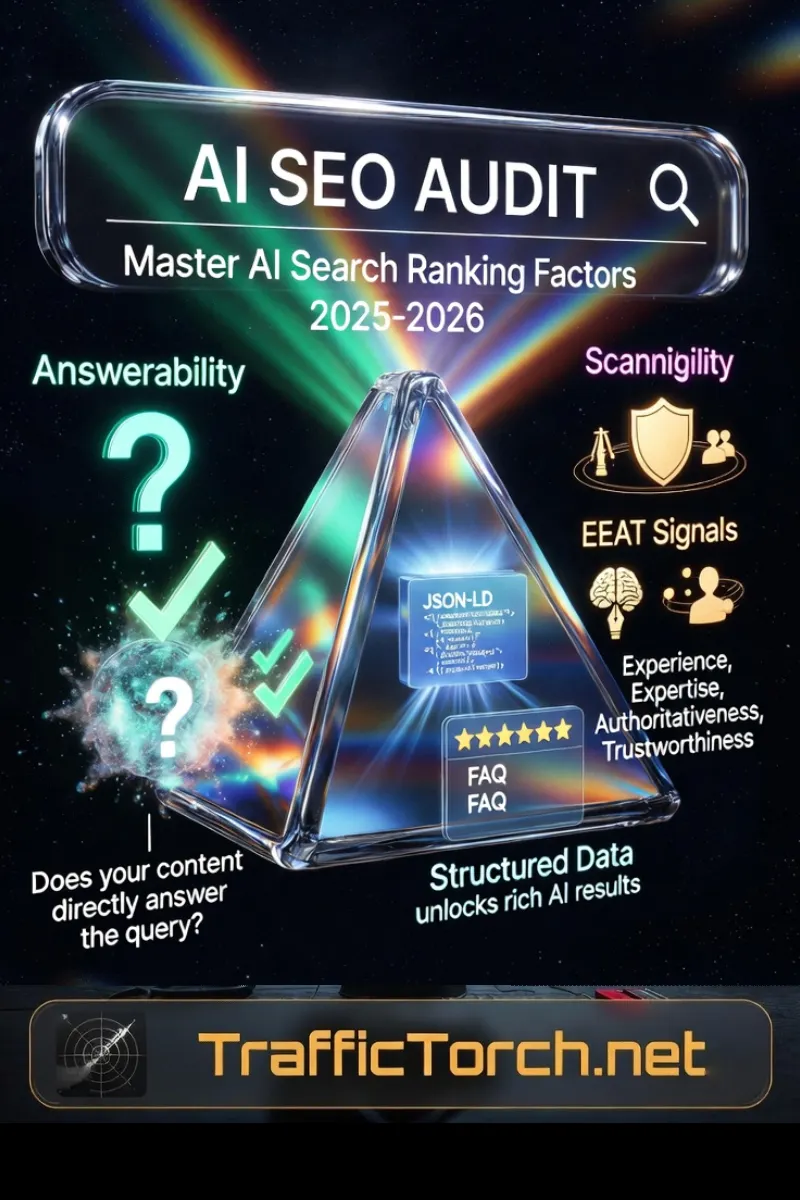

5 Must-Do Actions to Win AI Citations
In our hands-on testing of hundreds of pages that rank in AI answers, these five changes delivered the biggest visibility jumps.
Put the direct answer in the first 200 words. AI engines quote it verbatim in their responses.
Include your name, photo, bio, and expertise proof. Trust is the #1 factor AI uses to choose sources.
Machine-readable markup makes your answers instantly extractable for rich AI results.
First-hand testing, case studies, or exclusive stats prevent de-duplication and boost perceived value.
Address “you” directly, use headings, lists, tables, and short paragraphs. This makes content human and AI-friendly.
Do these five things and watch AI engines start citing your content.
Traditional SEO vs GEO, AEO & AIO
| Factor | Traditional SEO Focus | GEO & AEO Focus |
|---|---|---|
| Primary Goal: | Rank high in blue links. | Get directly cited/quoted in AI answers. |
| Content Structure: | Keyword density, H1–H6. | Bold answers early, lists, tables, schema. |
| Trust Signals: | Backlinks, domain authority. | Author bio, credentials, dates, trusted links. |
| Writing Style: | Keyword-optimized, formal. | Conversational “you” language, natural variation. |
| Unique Value: | Comprehensive coverage. | First-hand insights, original data, testing. |
AI engines reward pages that are easy to extract, trust, and quote.
Ai Tools
Ultimate AI Search Optimization Checklist
Checklist for AI-powered search results. Audit your page for Google AI Overviews, Perplexity, Grok, Gemini, ChatGPT citation potential. with deep analysis and priority fixes.
AI Search Optimizations 📊 ↓
- ✅ Add clear author bio with credentials, photo, and experience proof.
- ✅ Use structured data (JSON-LD FAQ, HowTo, Article schema) for easy extraction.
- ✅ Include unique insights, original data, case studies, or first-hand experience.
- ✅ Write in natural, conversational tone with varied sentence lengths.
- ✅ Lead with direct answers, bold key facts early in content.
- ✅ Use scannable formatting: headings, lists, tables, short paragraphs.
- ❌ Rely on thin, generic content without original value.
- ❌ Skip author information or GEO & AIO search signals entirely.
- ❌ Write in robotic, repetitive AI-generated style.
- ❌ Use walls of text without headings or visual breaks.
- ❌ Ignore schema markup and semantic HTML.
- ❌ Bury key answers deep in long paragraphs.
🔍 Signals for AI Engines ↓
🏗️ Content for LLMs ↓
⚖️ Actionable Outcomes ↓
AI search optimization tool - Learn your score and how to improve your website.
Why AI Search Optimization Matters? ↓
The Future of Search Is AI-Powered
Traditional Google rankings are evolving rapidly. AI search engines like Google AI Overviews, Perplexity, Grok, Gemini, ChatGPT Search, and others are becoming the primary discovery method.
These systems don’t just link — they cite, quote, and summarize content directly. High-citation pages experience massive direct traffic surges.
Key Benefits of Strong AI Search Optimization
Top-cited sources in AI answers receive thousands of clicks from users seeking full details.
Core algorithms weight EEAT, structure, and readability used in AI Overviews.
As AI answers gain influence, citation-optimized pages remain relevant long-term.
Most sites optimize only for classic SEO. AI-ready content out-cites generic pages.
Clear answers, scannable format, trustworthy signals boost engagement for humans and AI.
The Bottom Line
High AI search optimization scores multiply organic reach across traditional and generative engines.
Apply prioritized fixes → Re-run this free tool → Watch visibility and traffic grow.
Sites adapting to AI search optimization today influence tomorrow’s results.

Traffic Torch
AI Search Engine Optimization Audit Tool.
The AI Search Optimization Tool analyzes your content's readiness for AI-powered search engines, providing deep diagnostics, competitive insights, priority fixes, and educational guidance to improve visibility in Ai search results.

Ylia Callan – Lead Developer
Musician • Author • Researcher • Web Designer • TAFE NSW • Creator of privacy-first SEO & GEO web tools. Bridging creativity, consciousness exploration, and modern technology to build meaningful, performant, and user-centric experiences.
Explore my work - books on physics, philosophy, consciousness, music, and more – at yliacallan.github.io.
Modern Stack Setup
Traffic Torch runs on epic, scalable infrastructure: Hosted via GitHub Pages for blazing-fast static delivery and effortless updates. Protected and accelerated globally by Cloudflare with edge CDN, security, and performance optimizations.
We help publishers and marketers adapt to AI-powered search. This tool is based on real-world testing of pages across Google AI Overviews, Perplexity, Grok, ChatGTP and Gemini.
Published: 2026-01-01
Last updated: 2026-03-06