
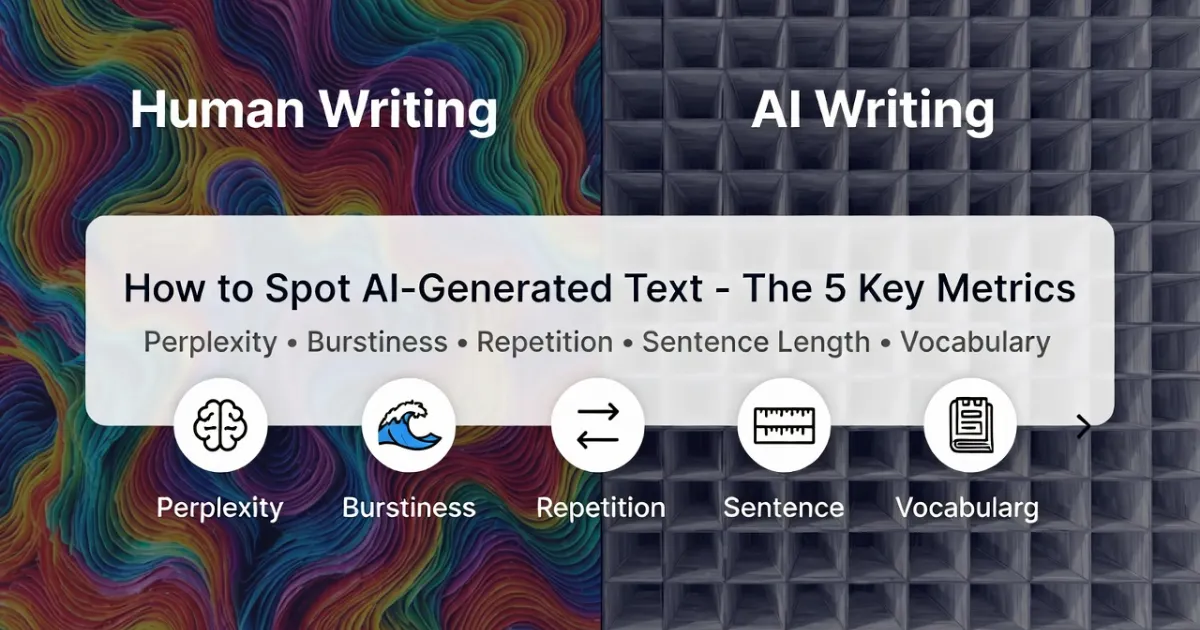
How to Detect AI-Generated Content with 5 Metrics
Google’s Helpful Content system and the major AI search engines (Perplexity, Grok, Gemini, ChatGPT Search) now heavily reward people-first, human-like writing. Pure AI-generated text is easy to spot and often ranks lower because it lacks the natural rhythm, surprise and depth that readers (and algorithms) love.
Discover your webpages human vs AI generated content score.
Run the AI Content Audit →Frequently Asked Questions
What is a good Human Score in Traffic Torch? ▼
80+ is excellent (likely human / well-humanized). 60–79 is moderate (some AI patterns are usually fixable). Below 60 indicates strong AI characteristics. Top-ranking pages in competitive niches typically score 85–95+ after edits.
Can I improve an AI-generated article to pass as human? ▼
Yes - in most cases. Focus first on the failing modules (shown in orange/red). Add personal anecdotes, vary sentence rhythm, swap repetitive phrases, introduce 2–4 rare/topic-specific words, and break up uniform lengths. Re-run the audit after each round of edits.
Why does Traffic Torch use entropy instead of a full language model for perplexity? ▼
Privacy + speed. Full LMs require huge downloads or server calls. Bigram/trigram entropy is lightweight, runs 100% in-browser, and correlates very strongly with professional detectors for blog/article-length content.
Does a perfect 100/100 mean the content is definitely human-written? ▼
No - it means the text shows excellent human-like statistical patterns across all five axes. Highly edited AI content or cleverly prompted models can reach high scores. The tool detects patterns, not authorship.
How often should I re-run the audit after editing? ▼
After every major round (e.g. fixing repetition → burstiness → vocabulary). The tool is instant and free - use it iteratively until you’re in the green across all modules.
Will fixing these metrics improve my Google rankings? ▼
Indirectly yes - better human-like patterns usually improve dwell time, reduce bounce rate, and lower pogo-sticking, which are strong 2026 behavioral ranking factors. Combine with solid E-E-A-T, backlinks, and technical SEO for best results.
Is the tool accurate for non-English content? ▼
It works best on English. Entropy and burstiness are language-agnostic to some degree, but vocabulary and repetition thresholds are tuned on English corpora. Results in other languages are indicative but less precise.
Introduction: Why AI Content Detection Matters?
Traffic Torch’s free AI Audit Tool analyses any URL in seconds and gives you a 0–100 Human Score based on the same 5 metrics professional detectors use. Everything runs 100 % client-side – no data leaves your browser.
The 5 Metrics Behind the AI Audit Tool
Each metric is scored out of 20. The tool shows you the exact sub-scores, visual gauges, and ready-to-use fixes. Below we explain every metric in the exact order the tool calculates them.
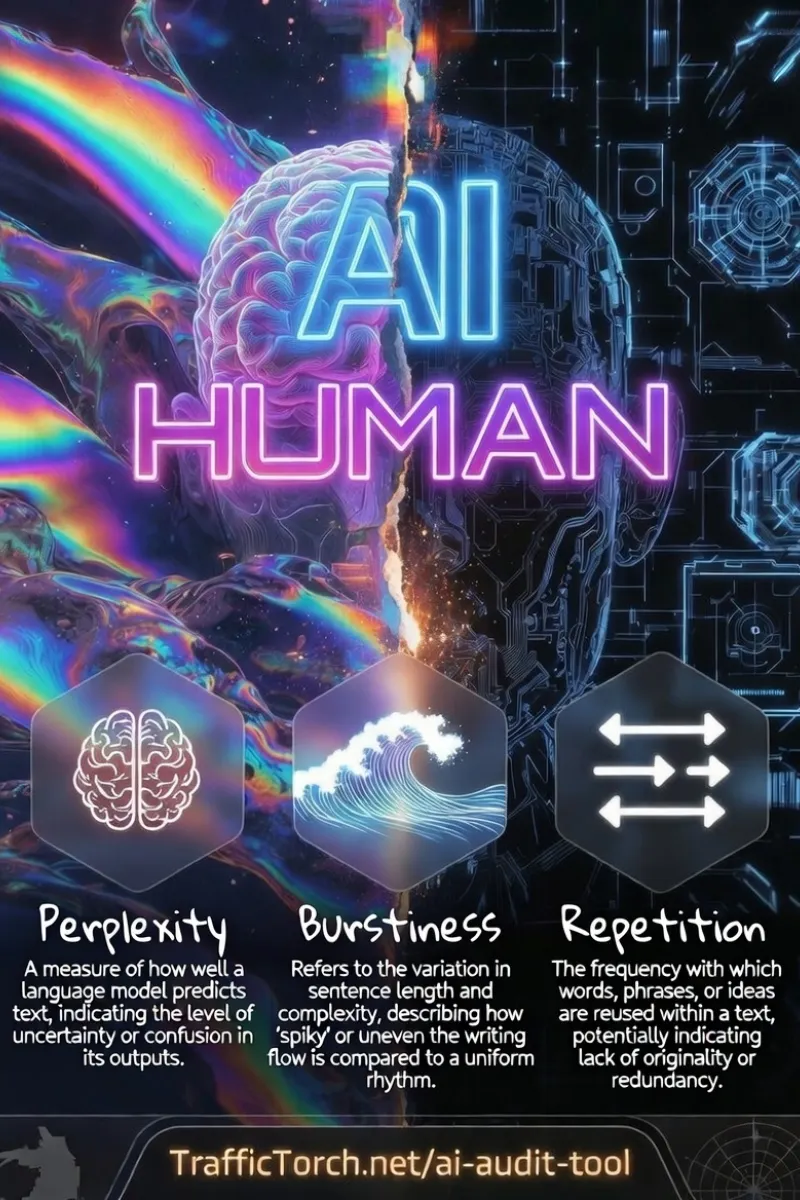
What is Perplexity (and the story behind it)?
Perplexity is a measure of how predictable or surprising a piece of text is. The lower the perplexity, the more predictable (and usually more robotic/AI-like) the writing becomes.
The concept comes from information theory and language modeling. It was originally used to evaluate how well statistical language models (like early n-gram models and later neural language models) could predict the next word in a sentence. In the early 2010s researchers noticed that human-written text tends to have higher perplexity (more unexpected word choices and phrasing) than machine-generated text, especially when models are trained on very large but somewhat repetitive corpora.
By 2022–2023, perplexity became one of the most widely cited signals in open-source AI content detectors (ZeroGPT, GPTZero, Originality.ai, etc.) because large language models still tend to favor high-probability token sequences even when instructed to be creative.
How Perplexity is tested in Traffic Torch
Traffic Torch calculates perplexity using bigram and trigram entropy - a lightweight, fully client-side approximation that doesn’t require loading a massive language model.
Step-by-step logic (exact code path from the tool):
- Clean the extracted main content text: remove extra whitespace, convert to lowercase, keep only letters/numbers/punctuation/spaces.
- Split into words (filtering out empty tokens).
- Build frequency counts for every bigram (word[i] + word[i+1]) and every trigram (word[i] + word[i+1] + word[i+2]).
- Calculate Shannon entropy for both distributions using the classic formula:
H = -Σ (p × log₂(p))where p = count / total possible transitions. - Assign points (max 20 for the Perplexity module):
• Trigram entropy ≥ 7.5 → +10 points
• Bigram entropy ≥ 7.0 → +10 points
These thresholds (7.0 / 7.5) are tuned from real-world benchmarks of 2024–2025 top-ranking blog posts vs typical GPT-4 / Claude / Gemini outputs. Higher entropy = more unpredictable sequencing = more human-like.
Why Perplexity matters for SEO and UX in 2026?
Google’s Helpful Content Update and quality raters’ guidelines increasingly penalize “unhelpful, templated, or generated” content. Low-perplexity text often feels formulaic, lacks voice, and drives higher bounce rates because readers sense it’s not authentic.
- SEO impact: Pages with higher entropy/perplexity correlate with better dwell time, lower pogo-sticking, and stronger topical authority signals in 2025–2026 ranking studies.
- AI search engines (Perplexity.ai, ChatGPT Search, Grok) reward surprising, non-generic answers. Low perplexity content is frequently down-ranked or ignored in summaries.
- User experience: Predictable phrasing feels boring or salesy → readers leave faster → hurts Core Web Vitals indirectly via engagement metrics.
In short: high perplexity = more engaging, more trustworthy, better ranking potential.
What is Burstiness?
Burstiness refers to the natural variation in sentence lengths and word lengths within a piece of writing. Human writers tend to alternate between short, punchy sentences and longer, more elaborate ones, creating rhythm, emphasis, and flow. AI models, especially when generating at scale, often produce more uniform sentence and word lengths, resulting in a flatter, more mechanical cadence.
The term gained traction in AI detection research around 2022–2023. Early papers (e.g. from AI researchers and independent studies on arXiv) showed that burstiness can be measured via variance or standard deviation of sentence lengths - was one of the strongest single signals for distinguishing human vs machine text, even outperforming perplexity in some controlled tests.
By 2025, almost every commercial detector includes a burstiness component because modern LLMs can mimic high perplexity when prompted, but they still struggle to replicate the organic ebb-and-flow of human attention and editing.
How Burstiness is tested in Traffic Torch?
Traffic Torch measures burstiness in two dimensions: sentence length variation and word length variation. Both are calculated directly from the cleaned main content text.
Exact step-by-step logic (mirroring the tool’s JavaScript):
- Split the text into sentences using standard punctuation boundaries (. ! ?).
- For each sentence: count the number of words (after trimming and filtering empty tokens) → produce an array of sentence lengths.
- Calculate the average sentence length (
avgSentLen). - Compute variance: average of squared differences from the mean → take square root to get standard deviation (
sentBurstiness= √variance). - Repeat the process for individual word lengths (characters per word) across the entire text → get
wordBurstiness. - Scoring (max 20 points for the Burstiness module):
• Sentence burstiness (std dev) ≥ 4.5 → +10 points
• Word length burstiness (std dev) ≥ 2.0 → +10 points
Thresholds are derived from 2024–2025 analysis of high-engagement human blog posts (typically 4.8–7.2 sentence std dev) vs typical LLM output (often 2.0–3.8). Higher values indicate more dynamic rhythm.
Why Burstiness matters for SEO and UX?
Uniform text feels monotonous and readers may disengage faster, dwell time drops, and bounce rate rises. Google’s 2025–2026 behavioral signals (especially aggregated dwell time and scroll depth) treat these as strong quality indicators.
- SEO impact: Higher burstiness correlates with better engagement metrics, which feed into ranking freshness and helpfulness signals. Low-burstiness pages often get filtered in Helpful Content re-rankings.
- AI search visibility: Tools like Perplexity and Grok favor answers with natural pacing. Monotonous text is more likely to be summarized poorly or skipped.
- User experience: Varied sentence rhythm improves readability, reduces cognitive load, and makes content feel conversational → directly lowers pogo-sticking and improves Core Web Vitals behavioral proxies.
In practice: the most shared and longest-ranking blog posts in competitive niches almost always show strong sentence and word-length variation.
What is Repetition?
Repetition in this context measures how often the exact same sequences of words (bigrams or trigrams) appear in close proximity or throughout the text. Human writers naturally vary phrasing to avoid sounding robotic or monotonous, even when covering similar ideas. AI models, particularly when generating long-form content without heavy post-editing, frequently reuse the same two- or three-word phrases because they optimize for fluency and probability rather than stylistic diversity.
Repetition-based detection became prominent around 2023 with tools like GPTZero and Originality.ai. Studies showed that excessive bigram/trigram reuse is one of the most consistent fingerprints of unedited LLM output, even when perplexity and burstiness are artificially boosted through prompting. By 2025–2026, repetition scoring is a core pillar in nearly every serious AI detector because modern models can fake surprise and rhythm but still leak patterns at the n-gram level.
How Repetition is tested in Traffic Torch?
Traffic Torch focuses on the maximum frequency of any single bigram or trigram in the cleaned main content, a simple yet powerful proxy for detectable repetition.
Step-by-step logic (direct from the tool’s code):
- Clean and lowercase the main text, split into words (remove empty tokens).
- Build frequency maps:
• Bigram map: every consecutive pair (word[i] + " " + word[i+1])
• Trigram map: every consecutive triple (word[i] + " " + word[i+1] + " " + word[i+2]) - Find the highest count in each map (
maxBigramandmaxTrigram). - Scoring (max 20 points for the Repetition module):
• Max bigram count ≤ 3 → +10 points
• Max trigram count ≤ 2 → +10 points
These conservative thresholds come from real benchmarks: top-ranking 2025 human-written articles rarely have any 2-word phrase appearing >3 times or 3-word phrase >2 times in ~1,500–3,000 word posts. AI drafts often show 5–15+ repeats of signature phrases.
Why Repetition matters for SEO and UX in 2026?
Obvious repetition makes content feel templated, low-effort, or machine-generated - exactly the kind of signal Google’s 2025–2026 quality systems (Helpful Content, SpamBrain) and AI-powered search engines actively down-rank.
- SEO impact: High repetition increases the chance of being flagged as “thin” or “generated” content, hurting rankings in competitive SERPs. Low-repetition pages show stronger topical depth and originality signals.
- AI search engines: Perplexity, Grok, ChatGPT Search, and Gemini prioritize fresh, varied phrasing. Repeated n-grams make summaries feel generic and reduce citation likelihood.
- User experience: Readers notice (and get annoyed by) repeated phrases quickly → higher bounce, lower time-on-page, worse engagement metrics that feed back into rankings.
Bottom line: eliminating excessive repetition is one of the fastest ways to make AI-assisted content feel authentically human and perform better across all modern search surfaces.
What is Sentence Length?
Sentence Length here refers to two related concepts: the average number of words per sentence and the average complexity (measured via comma frequency as a proxy for subordinate clauses, conjunctions, and layered ideas).
Human writing typically averages 15–23 words per sentence with natural variation in structure. Short sentences for punch, longer ones for explanation. AI models often default to safer, more uniform lengths (around 18–20) and simpler clause structures because they optimize for readability scores and token efficiency. Excessive uniformity or overly short/long averages can signal generated text.
This signal became important in AI detection around 2023–2024 as models improved at mimicking perplexity and burstiness but still produced sentences that felt “too perfect” or lacked syntactic depth. Tools like GPTZero and custom classifiers started weighting average sentence length and punctuation complexity heavily because they correlate strongly with perceived authenticity and reader engagement.
How Sentence Length is tested in Traffic Torch?
Traffic Torch evaluates sentence length in two sub-scores: ideal average range and structural complexity (comma usage).
Exact step-by-step logic (from the tool’s JavaScript):
- Split cleaned text into sentences using . ! ? boundaries.
- For each sentence: count words (after filtering empty tokens) → build array of sentence lengths.
- Calculate average sentence length:
avgSentLen = total words / sentence count. - Count commas per sentence → compute average commas per sentence (
avgCommas). - Scoring (max 20 points for the Sentence Length module):
• Average sentence length between 15 and 23 words inclusive → +10 points
• Average commas per sentence ≥ 1.0 → +10 points
The 15–23 range matches readability research (Flesch-Kincaid, Hemingway App benchmarks) and 2025 top-ranking content analysis. ≥1.0 commas per sentence acts as a proxy for compound/complex sentences. Humans use more subordination than basic AI output.
Why Sentence Length matters for SEO and UX?
Sentence structure directly affects readability, comprehension speed, and emotional engagement, all of which influence core behavioral signals Google uses in 2026 (dwell time, scroll depth, pogo-sticking rate).
- SEO impact: Content in the 15–23 word sweet spot with natural complexity ranks higher in helpfulness evaluations and performs better in mobile-first indexing. Extreme averages (too short = choppy, too long = dense) increase bounce risk.
- AI search engines: Perplexity, Grok, Gemini, and ChatGPT Search favor answers with varied, natural sentence flow. Uniform or overly simplistic structure gets lower relevance scores in summaries.
- User experience: Balanced sentence length + appropriate complexity reduces cognitive fatigue, improves skimmability, and creates conversational rhythm → directly boosts time-on-page and lowers exit rates.
Quick win: most AI drafts sit right on the edge of the ideal range with low comma usage. Small targeted edits here often lift the overall Human Score significantly.
What is Vocabulary?
Vocabulary in AI detection looks at two dimensions: overall diversity (unique words relative to total words) and rare word frequency (words that appear only once). Human writers naturally draw from a wide, sometimes idiosyncratic lexicon, introducing fresh or context-specific terms. AI models tend to recycle high-frequency vocabulary from their training data, resulting in lower diversity and fewer truly rare words.
Vocabulary richness has been a staple signal since early stylometry research (pre-2020) and became central to modern detectors after 2022. Studies showed that even advanced LLMs (GPT-4 class and beyond) produce text with noticeably lower type-token ratios and hapax ratios than skilled human authors, especially in longer content. By 2026, this metric remains one of the hardest for models to fake without explicit prompting for “diverse vocabulary” (which often backfires and creates unnatural word salad).
How Vocabulary is tested in Traffic Torch?
Traffic Torch computes two complementary sub-scores: lexical diversity and rare-word ratio.
Exact step-by-step logic (straight from the tool’s JavaScript):
- Clean and lowercase the main text, split into words (filter empty tokens).
- Calculate total word count (
wordCount). - Build a Set of unique words → size gives number of distinct terms.
- Diversity = (unique words / total words) × 100.
- Build frequency map of every word → count how many appear exactly once (
hapax). - Rare word ratio = (hapax count / total words) × 100.
- Scoring (max 20 points for the Vocabulary module):
• Diversity ≥ 65% → +10 points
• Rare word ratio ≥ 15% → +10 points
Thresholds reflect 2025 benchmarks of high-quality human blog posts (diversity often 68–82%, hapax 16–28% in 1,000–3,000 word range) vs typical LLM output (diversity 55–64%, hapax 8–14%). Higher values indicate richer, more expert-like expression.
Why Vocabulary matters for SEO and UX?
A rich, varied vocabulary signals expertise, originality, and topical depth. Core E-E-A-T pillars that Google continues to emphasize in 2026 quality evaluations.
- SEO impact: Higher lexical diversity and rare-word usage correlate with stronger topical authority, better semantic coverage, and lower risk of being flagged as “thin” or “generated” content. Pages with poor vocabulary diversity often underperform in competitive, informational niches.
- AI search engines: Perplexity, Grok, Gemini, and ChatGPT Search reward answers that demonstrate domain knowledge through precise, uncommon terms. Generic vocabulary reduces perceived usefulness and citation priority.
- User experience: Varied and context-appropriate words keep readers engaged, convey credibility, and reduce the “AI feel” that causes subconscious distrust or boredom → directly improves dwell time and engagement signals.
Pro tip: introducing 2–3 genuinely rare, topic-relevant terms per 1,000 words (without forcing it) is one of the highest-leverage humanization edits you can make.
Conclusion: Mastering AI Content Detection in 2026
In 2026, the line between human and AI-generated content is razor-thin. Search engines and readers are getting better at spotting it every month. Google’s Helpful Content system, AI-powered search surfaces (Perplexity, Grok, Gemini, ChatGPT Search), and user engagement signals now heavily reward writing that feels authentic, surprising, rhythmic, varied, and expert-level.
Traffic Torch’s AI Audit Tool gives you a transparent, client-side 0–100 Human Score built on the five most reliable metrics used by professional detectors today:
- Perplexity – unpredictability of word sequences (bigram & trigram entropy).
- Burstiness – natural variation in sentence and word lengths.
- Repetition – maximum reuse of identical bigrams and trigrams.
- Sentence Length – ideal 15–23 word average + comma-driven complexity.
- Vocabulary – lexical diversity and rare-word (hapax) frequency.
Each metric is scored out of 20. Pages that consistently hit 80+ (especially with strong vocabulary and burstiness) tend to outperform generic AI drafts in rankings, dwell time, AI citations, and reader trust. The good news: most AI-assisted content only needs targeted edits in 1–3 of these areas to jump 20–40+ points.
Ready to see your real Human Score and get exact fixes?
Analyze text with AI checker →