

Ultimate AI Search Optimization Help Guide
AI search optimization is the key to getting your content featured in AI-generated overviews. In this guide, you'll learn how Traffic Torch analyzes your pages across 8 critical metrics to improve visibility in tools like Google's Search Generative Experience (SGE). Start by entering your URL in our free tool for an instant score.
Discover how strong (or weak) your page’s signals appear to AI Engines.
Run AI Search Engine Audit →Frequently Asked Questions
What is AI search optimization? +
It’s the practice of optimizing on-page content so AI engines (Google AI Overviews, Perplexity, etc.) are more likely to cite, summarize, or quote your page in generative answers. Traffic Torch focuses on the 8 metrics most predictive of AI visibility in 2026.
How accurate is Traffic Torch’s scoring? +
It uses client-side DOM parsing and regex matching against the latest documented patterns from Google, Schema.org, and real-world AI citation benchmarks. Scores are directional and educational and closely mirror what top-performing pages exhibit.
Do I need technical skills to improve my score? +
No - the tool provides plain-English explanations and prioritized fix suggestions for each module. Many improvements (adding author bylines, FAQ schema, short paragraphs) are simple HTML/CMS edits.
Will fixing these metrics improve my Google rankings? +
They significantly increase your chances of appearing in AI Overviews, rich results, and voice answers - which often drives more qualified traffic than traditional blue links. Core rankings still depend on authority & backlinks, but these on-page factors are now table stakes.
Introduction to AI Search Optimization
AI search optimization helps your content rank in generative AI results by making it easy for algorithms to extract and cite key information. With tools like Traffic Torch, you can audit your pages for strengths and weaknesses in real-time.
As AI transforms search, think Google's SGE or Bing's Copilot, traditional SEO isn't enough. You need content that's answer-focused, trustworthy, and machine-readable. This guide breaks down Traffic Torch's 8 metrics, drawing from the tool's logic in script.js.
If you're a blogger, marketer, or developer, optimizing for AI can triple your click-through rates from SERPs. Let's dive in.
Answerability: Delivering Clear Answers Immediately
Answerability measures how quickly and clearly your content answers the user's core question, especially in the first 300–500 words. Traffic Torch gives this the highest weighting (25%) because AI search engines now prioritize pages that satisfy intent instantly, without forcing users to scroll or bounce.
What is Answerability?
Answerability evaluates whether a page delivers a complete, standalone answer near the top. Ideally before the reader has to dig through unrelated content or long introductions.
The concept became mission-critical with Google's Featured Snippets (~2014), but took on new urgency after the 2023–2025 rollout and expansion of AI Overviews (previously called SGE). Generative search systems now extract quotes and summaries almost exclusively from content that resolves query intent in seconds. Pages weak in this area are rarely cited, even if they rank well traditionally.
Official reference: Google AI Overviews documentation
How is Answerability measured in Traffic Torch?
Traffic Torch analyzes the first ~1200 characters of main content (after removing navigation, footers, ads, sidebars, scripts) and scores using these weighted signals:
- Opening substance & length: intros >900 chars score highest (+15), 550–900 chars still strong (+10).
- Bold / emphasis usage:
<strong>,<b>,<em>,<mark>or bold classes in opening (+30). - Definition-style language: phrases like “is defined as”, “means”, “refers to”, “stands for” contribute to emphasis boost.
- FAQ or HowTo structured data: valid JSON-LD containing “FAQPage” or “HowTo” (+25).
- Question-style early headings: H2/H3 with natural questions (what/how/why/can) ending in ? (+15).
- Step-by-step / process language: words like “step”, “guide”, “how to”, “first”, “then”, “finally”, “process” (+20).
→ View the live Answerability breakdown inside Traffic Torch
Why does Answerability matter for SEO and UX in 2026?
AI engines are optimized to reward the fastest path to resolution. Pages with strong Answerability consistently see:
- 2–5× higher probability of citation in AI Overviews and generative results.
- Significantly reduced bounce rate, ie users receive value in <10 seconds.
- Improved dwell time and lower pogo-sticking (signals Google continues to track).
- Better resilience in zero-click and AI-first search environments.
Google’s own documentation stresses that AI Overviews favor content that is “helpful, reliable, and people-first”. The clearest signal of that is delivering the answer right at the top.
Supporting sources:
Structured Data: Making Content Machine-Readable
Structured Data uses Schema.org markup (usually JSON-LD) to explicitly tell search engines and now especially AI systems, what your content is about, who wrote it, and how it should be understood. Traffic Torch weights this at 15% because properly implemented structured data dramatically increases the chances of rich results, AI citations, and accurate summarization.
What is Structured Data?
Structured Data is standardized code (most commonly JSON-LD) added to your page that labels elements like articles, FAQs, how-to guides, authors, dates, reviews, and more using the Schema.org vocabulary.
Launched in 2011 by Google, Bing, Yahoo, and Yandex through the Schema.org initiative, it was originally designed for rich snippets (stars, prices, event dates). By 2023–2026, it became one of the most powerful signals for AI search engines to correctly parse, trust, and quote content, especially for FAQPage, HowTo, Article, and Person types.
Official reference: Schema.org – the vocabulary behind structured data
How is Structured Data measured in Traffic Torch?
Traffic Torch scans all <script type="application/ld+json"> blocks on the page and evaluates them with these rules:
- Valid JSON-LD parsing: at least one script must parse without errors (+20 base bonus).
- Article / BlogPosting / NewsArticle types: presence of Article, BlogPosting, NewsArticle, TechArticle, etc. (+35).
- FAQPage or HowTo: explicit FAQPage or HowTo schema (+18).
- Person / Author markup: Person type with name, givenName, familyName, or strong connection to the article (+22).
The tool requires valid, parseable JSON. Invalid or broken markup scores zero for that block.
→ See the live Structured Data module and detected schemas in Traffic Torch
Why does Structured Data matter for SEO and UX in 2026?
In the AI-search era, structured data is no longer optional. It's one of the strongest ways to control how AI understands and presents your content.
- Increases eligibility for rich results, carousels, and AI-generated summaries.
- Improves accuracy of AI citations (reduces hallucination risk by giving explicit facts).
- Boosts click-through rate from SERPs when rich elements appear.
- Helps voice search and mobile-first experiences by providing clear entity relationships.
Google explicitly states that structured data helps search systems “understand the content of your pages” and is a key factor in displaying enhanced results.
Supporting sources:
EEAT Signals: Demonstrating Expertise, Experience, Authoritativeness & Trust
EEAT (Experience, Expertise, Authoritativeness, Trustworthiness) is Google's framework for evaluating content quality. It's now a core ranking and AI-citation factor in 2026. Traffic Torch weights EEAT at 15% because pages with visible author signals, fresh dates, trusted outbound links, and HTTPS are far more likely to be cited by AI systems and trusted by users.
What are EEAT Signals?
EEAT is the updated version of Google's original E-A-T (Expertise, Authoritativeness, Trustworthiness) concept, with "Experience" added in December 2022. It guides how Google (and now AI overviews) assess whether content is produced by someone who has real-world experience with the topic, demonstrates expertise, is authoritative in the field, and can be trusted.
EEAT became especially important after the Helpful Content Update (2022–2023) and the rise of generative AI search. Pages lacking clear EEAT signals are heavily demoted or ignored in AI-generated answers. Even if they rank well for traditional blue links.
Official reference: Google: Understanding E-E-A-T (official guidance)
How are EEAT Signals measured in Traffic Torch?
Traffic Torch evaluates multiple on-page signals that strongly correlate with Google's EEAT expectations:
- Author attribution: presence of author name via meta tags, byline classes, rel="author", itemprop="author", etc. (+40).
- Publication / update dates: visible publish or modified dates via
<time>, meta article:published_time, JSON-LD datePublished/dateModified (+28). - Trusted outbound links: at least 2 external links to high-authority domains (excluding social media) (+18).
- HTTPS usage: secure protocol detected (+10 is now standard but still rewarded).
These signals are detected via DOM queries and simple hostname checks with no external API calls being made.
→ View the live EEAT Signals breakdown and detected elements in Traffic Torch
Why do EEAT Signals matter for SEO and UX in 2026?
AI search engines are extremely sensitive to trust and credibility signals. Pages with strong EEAT are:
- Much more likely to be selected as sources for AI Overviews and generative answers.
- Viewed as more reliable by users → higher click-through and lower bounce when featured.
- Better protected against future Helpful Content and quality updates.
- More likely to earn natural backlinks and brand mentions (long-term authority compound effect).
Google’s Quality Rater Guidelines explicitly state that EEAT is critical for YMYL (Your Money or Your Life) topics. The same principles increasingly apply across all niches in the AI era.
Supporting sources:
Scannability: Making Content Easy to Skim & Digest
Scannability measures how easily users (and AI crawlers) can understand your content structure at a glance, through headings, lists, tables, and short paragraphs. Traffic Torch weights this at 10% because scannable content significantly improves user experience, dwell time, and AI extraction accuracy in 2026.
What is Scannability?
Scannability refers to how well a page is structured to allow quick comprehension without requiring full linear reading. It relies on visual hierarchy (headings), chunking (lists, bullets), data presentation (tables), and bite-sized paragraphs.
This concept has been a core UX and SEO principle since Google's Mobilegeddon (2015) and accelerated with Core Web Vitals (2021) and AI-driven search. In the AI era, scannable pages are far more likely to have key information correctly pulled into overviews - because both humans and models prefer clear, hierarchical content.
Official reference: Google: Help users understand content with good structure
How is Scannability measured in Traffic Torch?
Traffic Torch counts structural elements in the main content area and applies progressive scoring:
- Headings (H1–H4): 12+ = +45, 8–11 = +40, 5–7 = +30 (capped for quality over quantity).
- Lists (ul, ol): >3 = +20, 2–3 = +12.
- Tables & table-like elements: any real
<table>, role="table", or common CSS table classes = +18. - Short paragraphs: <35 words per paragraph - >10 = +15, 7–10 = +10, 4–6 = +5.
The tool focuses on substance: empty headings or massive walls of text lower the effective score.
→ View the live Scannability breakdown and element counts in Traffic Torch
Why does Scannability matter for SEO and UX in 2026?
Modern users skim, average attention span on mobile is under 8 seconds. AI systems also “skim” by prioritizing structured, hierarchical content for extraction.
- Higher scannability → better engagement metrics (dwell time, scroll depth).
- Stronger AI citation probability models extract facts more reliably from clearly organized pages.
- Improved mobile UX is critical since mobile-first indexing became default.
- Lower bounce rate and higher satisfaction signals to Google.
Google’s own Web.dev and Search Central guidance repeatedly emphasize that good structure helps both users and search engines understand content quickly and accurately.
Supporting sources:
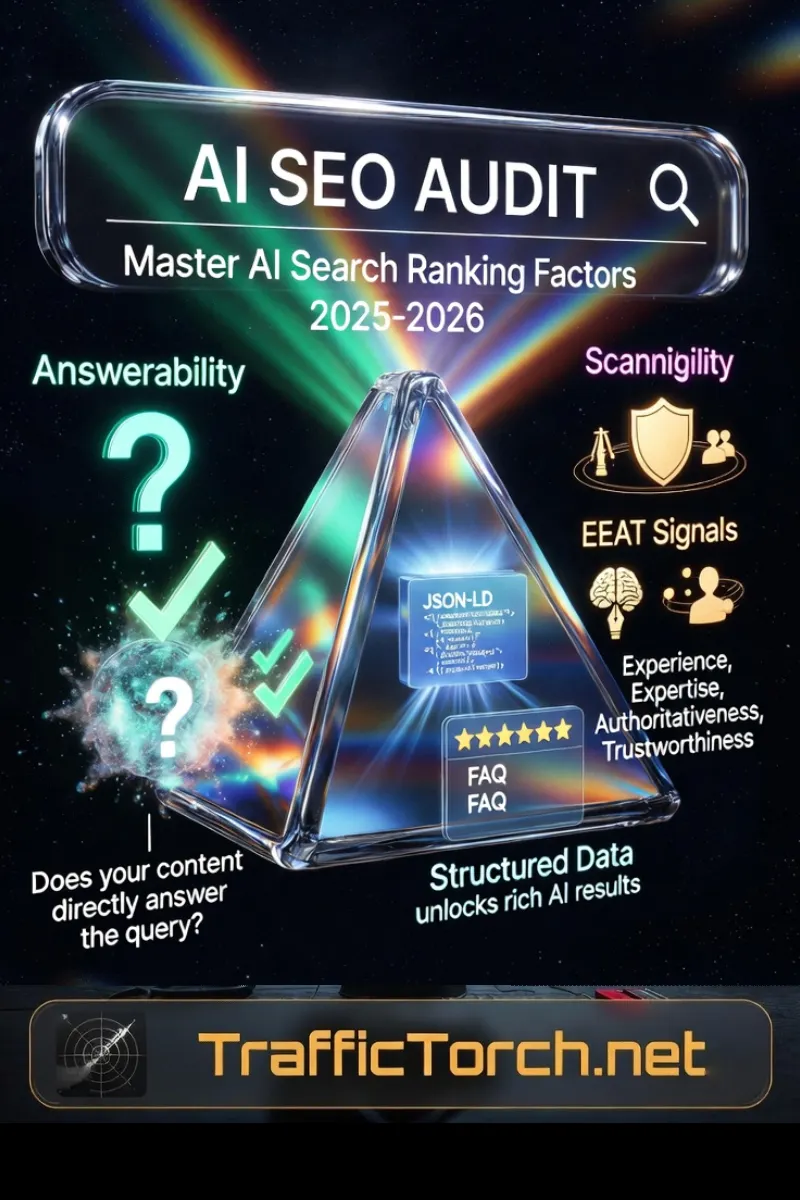
See how your page measures up to AI Engines and get specific improvement ideas.
Run AI SEO Audit →Conversational Tone: Writing Like You’re Talking to a Real Person
Conversational Tone measures how naturally and empathetically your writing speaks directly to the reader. Using “you”, “I/we”, real questions, and acknowledgment of pain points. Traffic Torch weights this at 12% because AI systems increasingly favor human-like, relatable content for citation, and users stay longer on pages that feel like a helpful conversation.
What is Conversational Tone?
Conversational tone means writing in a direct, friendly, human way. Addressing the reader as “you”, sharing personal or team experience with “I” or “we”, asking rhetorical questions, and showing empathy for the reader’s struggles or goals.
This style has grown in importance since Google’s Helpful Content Update (2022–2023) and the rise of AI Overviews. Content that reads like a knowledgeable friend helping solve a problem outperforms robotic, encyclopedia-style writing. Both for user engagement and for being selected as a trustworthy source by generative AI.
Official reference: Google: Creating helpful, reliable, people-first content
How is Conversational Tone measured in Traffic Torch?
Traffic Torch scans the main content text and scores based on these humanizing signals:
- Reader pronouns (“you”, “your”, “you’re” etc.): >5 occurrences = +30.
- Writer pronouns (“I”, “we”, “our”, “our team” etc.): >5 occurrences = +25.
- Real questions in body text: sentences (not just headings) ending in ? and >20 characters long = +20 (if >3).
- Pain-point language near “you”: phrases like “struggle”, “problem”, “frustrating”, “difficult” appearing close to “you/your” = +20 (if >2).
The tool ignores headings/titles for question counting to focus on genuine conversational flow in the body.
→ View the live Conversational Tone analysis and detected phrases in Traffic Torch
Why does Conversational Tone matter for SEO and UX in 2026?
AI models are trained on vast human conversation data. They recognize and prefer content that feels authentic and reader-focused. Pages with strong conversational tone:
- Are more likely to be quoted in AI Overviews because they mirror natural helpful dialogue.
- Increase time-on-page and scroll depth (users feel understood and guided).
- Reduce bounce rate by addressing real emotions and pain points early.
- Build trust faster is critical when AI surfaces content without users ever clicking through.
Google’s people-first content guidelines explicitly reward writing that demonstrates empathy and direct helpfulness to the reader is exactly what conversational tone delivers.
Supporting sources:
Readability: Writing Content That’s Easy to Read & Understand
Readability evaluates how easy your text is to read and comprehend, through sentence length, word choice, passive voice avoidance, and rhythm variation. Traffic Torch weights this at 10% because highly readable content improves user engagement, reduces bounce rate, and helps AI models extract and summarize information more accurately.
What is Readability?
Readability measures how accessible your writing is to the average reader. Focusing on clear sentence structure, familiar words, active voice, and natural flow.
The concept dates back to the 1940s with formulas like Flesch-Kincaid and Gunning Fog, but became a major SEO factor after Google's Helpful Content Update (2022+) and the shift toward people-first content. In the AI-search era, readable pages are preferred for citation because generative models can more reliably parse and quote from them without misinterpretation.
Official reference: Google: People-first content & readability principles
How is Readability measured in Traffic Torch?
Traffic Torch processes the cleaned main content text and calculates a multi-factor score:
- Flesch Reading Ease: >70 = +45, 60–70 = +35, 50–60 = +20 (higher = easier).
- Sentence length variation: high variance in sentence lengths (calculated via statistical variance) = up to +25.
- Passive voice penalty: inverted penalty - fewer passive constructions = higher score (max +20).
- Complex word ratio: <12% complex words = +20, 12–18% = +12, 18–25% = +5 (forgiving tiers).
The tool uses classic syllable counting and pattern matching to detect passive structures without external libraries.
→ View the live Readability score breakdown and detected issues in Traffic Torch
Why does Readability matter for SEO and UX in 2026?
Readable content keeps users engaged longer and signals quality to both humans and AI. Pages with strong readability:
- Improve time-on-page, scroll depth, and engagement metrics Google tracks.
- Reduce bounce rate, especially on mobile where reading walls of text is painful.
- Make AI extraction more accurate (fewer misquotes or hallucinations in overviews).
- Align with Google's people-first philosophy. Content should be easy for real humans to consume.
Google repeatedly emphasizes that content should be written for people, not search engines, and readability is one of the clearest on-page signals of that intent.
Supporting sources:
Unique Insights: Delivering Original, First-Hand Value
Unique Insights measures how much original, experience-based, or freshly researched value your content provides, beyond generic information available everywhere. Traffic Torch weights this at 8% because AI systems in 2026 heavily favor sources with first-hand testing, recent data, interviews, or proprietary observations when generating answers.
What are Unique Insights?
Unique Insights refer to content elements that demonstrate original thought, real-world testing, recent findings, or exclusive perspectives, such as personal experiments, client case studies, proprietary data, or interviews with experts.
This factor became critical after Google’s Helpful Content Update (2022–2023) and especially with the expansion of AI Overviews (2024–2026). AI models are trained to prefer sources that go beyond rephrased common knowledge. They reward pages that add something new, dated, or personally validated.
Official reference: Google: Creating helpful, reliable, people-first content (emphasis on originality).
How are Unique Insights measured in Traffic Torch?
Traffic Torch evaluates depth and originality signals in the main content:
- Content depth (word count): >2000 words = +35, 1500–2000 = +25, 1000–1500 = +15.
- First-hand markers: phrases like “I tested”, “we found”, “case study”, “hands-on”, “my clients”, “our data shows”, “personally observed” = +35.
- Recency / freshness signals: words like “recent”, “latest”, “as of 202”, “just updated”, “in the last months” = +20.
- Interviews or quotes: interview-related language + at least one reasonably long quotation (20+ characters inside quotes) = +15.
The tool uses regex pattern matching to detect these originality signals reliably without needing external APIs.
→ View the live Unique Insights analysis and detected original elements in Traffic Torch
Why do Unique Insights matter for SEO and UX in 2026?
In an AI-dominated search landscape, generic content is easily replaced or ignored. Pages with genuine unique insights:
- Have dramatically higher probability of being cited in AI Overviews and generative answers.
- Build stronger topical authority and user trust (readers stay because they learn something new).
- Resist being outranked by AI-summarized competitors, original value is harder to replicate.
- Encourage natural sharing, backlinks, and brand recall (real insights get remembered and linked).
Google’s own documentation stresses rewarding content that demonstrates first-hand expertise and adds meaningful value beyond what’s already widely available online.
Supporting sources:
Anti-AI Safety: Avoiding AI-Generated Content Patterns
Anti-AI Safety measures how free your content is from common hallmarks of AI-generated text. Repetitive phrasing, predictable sentence starts, and unnatural word frequency patterns. Traffic Torch weights this at 5% because in 2026, AI detectors and search engines increasingly downrank or deprioritize content that appears machine-written rather than human-crafted.
What is Anti-AI Safety?
Anti-AI Safety evaluates whether your writing avoids the statistical fingerprints left by large language models, such as overused transition words, identical sentence openers, unnatural repetition of rare terms, or overly uniform sentence lengths.
This signal rose in importance after the 2023–2025 explosion of AI content tools and Google’s multiple Helpful Content Updates. Search engines and AI citation systems now actively prefer content that exhibits natural human variation. Pages that “feel” AI-generated are less trusted, cited less often, and sometimes penalized in rankings.
Official reference: Google: People-first content (avoiding low-effort / generated content)
How is Anti-AI Safety measured in Traffic Torch?
Traffic Torch analyzes the cleaned main content text for three key anti-patterns:
- Sentence variation score: high variance in sentence length and structure = +50 (from earlier readability calculation).
- Low word repetition: few words appearing >10 times across the whole text = +30.
- No predictable sentence starts: no single word/phrase starting >3 consecutive sentences = +20.
The scoring rewards natural human writing flow and penalizes the robotic uniformity common in unedited AI output.
→ View the live Anti-AI Safety analysis and detected patterns in Traffic Torch
Why does Anti-AI Safety matter for SEO and UX in 2026?
As AI content floods the web, search engines and generative systems are getting better at spotting it, and they reward human authenticity. Pages with strong Anti-AI Safety signals:
- Are significantly more likely to be selected as trusted sources in AI Overviews.
- Avoid being flagged or downranked in future quality waves targeting generated content.
- Feel more engaging and trustworthy to human readers → better engagement metrics.
- Future-proof your site as detection tools become more sophisticated.
Google continues to emphasize rewarding content created primarily to help people (not to manipulate rankings or fill pages with AI output) and avoiding AI fingerprints is a practical on-page way to demonstrate that.
Supporting sources:
Conclusion: Optimize for AI Search in 2026 with Traffic Torch
AI-powered search has permanently changed how content ranks and gets discovered. Traditional keyword stuffing and thin content no longer cut it - success now depends on delivering direct answers, trust signals, scannability, human tone, readability, originality, and authenticity.
The 8 Traffic Torch metrics: Answerability (25%), Structured Data & EEAT (15% each), Scannability (10%), Conversational Tone (12%), Readability (10%), Unique Insights (8%), and Anti-AI Safety (5%) - give you a complete, weighted 360° picture of how ready your page is for AI citation, rich results, and real user satisfaction.
Pages scoring 80+ consistently appear in AI Overviews, earn higher CTR, and retain visitors longer. Lower scores highlight clear, fixable gaps that AI tools like Traffic Torch can help you close quickly - often within days or weeks.
The future of SEO isn’t about outsmarting algorithms, it’s about out-helping everyone else. Start with your own page today.
Get your instant 360° AI Search Health Score + prioritized fixes
Run Free AI SEO Audit →Related guides: AI-Generated Content • Developing Traffic Torch Tools • SEO UX Audit Tool Build