
SEO Keyword Help Guide: Optimize Your Page for Better Rankings
Struggling to rank higher in search results? Keyword optimization is key: strategically place your target keyword in meta titles, headings, content, images, anchors, and URLs to signal relevance to Google. This guide explains each factor: What it is, how it's tested, and why it matters for SEO and UX. You'll learn to boost CTR by 25-40%, impressions by 15-30%, and organic traffic.
Introduction to Keyword Optimization: From History to Modern SEO
Keyword optimization started in the 1990s with early search engines like AltaVista, where stuffing keywords could game rankings. Google's PageRank in 1998 shifted focus to natural relevance.
Today, with AI like BERT (2019), keywords must align with user intent. Tools like Traffic Torch's Keyword Tool evolved from manual audits to automated scans, helping sites rank in competitive SERPs.
This guide covers six core modules, drawing from Google's SEO Starter Guide and studies like Ahrefs' ranking factors research.
See your SEO Keywords score in seconds.
Run an instant analysis with Traffic Torch.
Test Your webpage SEO Keywords →Frequently Asked Questions
What is the ideal keyword placement strategy in 2026? ▼
Focus on natural integration: primary keyword in meta title (front-loaded), H1, first 100–150 words, image alts (main visuals), and 1–2 strategic internal anchors. Support with secondary terms in subheadings and body. Aim for comprehensive depth (800–2,500+ words) over forced density.
How important is keyword density today? ▼
Density matters less than depth and intent satisfaction. Target 0.8–2.2% naturally. Pages with 1,500+ high-quality words and balanced keyword usage consistently outperform thin content, especially for competitive queries and AI overviews.
Does schema markup still help rankings in 2026? ▼
Indirectly - yes. Schema doesn’t directly boost core rankings, but it unlocks rich results (stars, FAQs, carousels) that dramatically increase CTR and visibility in zero-click SERPs and AI-generated answers. Article, FAQPage, and HowTo schemas are the most impactful for blog/content pages.
Should I put the keyword in the URL? ▼
Yes - if it’s natural and doesn’t require breaking existing URLs. A clean, keyword-containing URL (e.g. /best-seo-tools-2026) improves CTR from SERPs and reinforces topical relevance. If changing URLs, use 301 redirects and update internal links/sitemap.
How often should I re-audit my pages? ▼
Every time you significantly update content, after major Google core updates, or quarterly for high-traffic pages. Use Traffic Torch’s instant audit to track progress after fixes, most noticeable CTR and position changes appear within 7–30 days post-reindexing.
Meta Title & Description
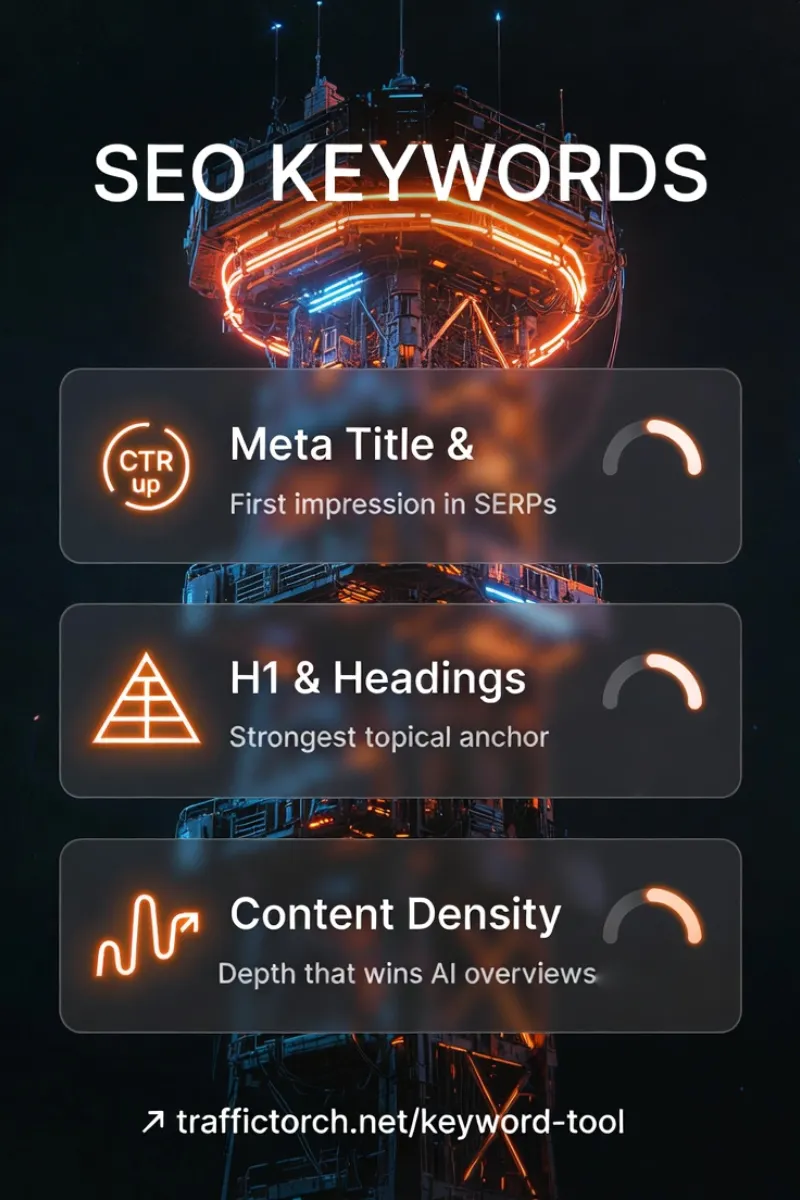
Including your target keyword naturally in both the page title (under 60 characters) and meta description (under 155 characters) is still one of the strongest on-page SEO signals in 2026. Google continues to use these elements heavily for ranking relevance and displaying results. Optimized titles & descriptions can increase click-through rates by 20–40% and help pages rank higher for exact-match and related queries.
What It Is & Its Evolution?
The meta title (the <title> tag) is the clickable blue headline users see in Google search results. The meta description is the short summary paragraph displayed below it.
These elements have been fundamental since the earliest search engines. In 1993–1996 they were heavily abused (keyword stuffing), but after Google’s rise and multiple algorithm updates. Especially the 2009 “title & snippet rewrite” shift and Helpful Content updates (2022–2025) the focus moved to user-first relevance and natural language.
Today they serve three masters:
- Search engines - primary relevance signal for the query
- Users decide whether to click based on title + description
- AI overviews & voice search often pull directly from optimized snippets
How Traffic Torch Tests It?
Our tool fetches your live page through a privacy-respecting proxy, parses the real DOM, and performs the following checks:
-
✓
Exact phrase match: Counts full keyword appearances (case-insensitive).
-
✓
Cleaned variant match: Removes common stop words (the, a, an, in, of…) and still awards partial credit if core terms appear.
-
✓
Length awareness: Flags titles >60 chars and descriptions >155 chars (even if keyword present).
-
⚠
Truncation preview: Shows how Google is likely to display your title & description on desktop & mobile.
Methodology inspired by Google’s official title link documentation and web.dev best practices.
Why It Matters for SEO & User Experience?
SEO Impact
- Primary ranking signal: Keyword in title remains one of top 3 on-page factors (Ahrefs, Semrush studies 2024–2025).
- Exact & semantic match: Helps rank for long-tail and voice queries.
- Rich results eligibility: Clean titles feed sitelinks, featured snippets, AI overviews.
UX & Business Impact
- CTR lift: 20–40% higher clicks when keyword + benefit appear early.
- Lower bounce rate: Sets accurate expectations → better user satisfaction.
- Brand trust: Professional, keyword-relevant snippets look more authoritative.
H1 & Headings
Placing your primary target keyword naturally in the H1 heading remains one of the most powerful on-page SEO signals in 2026. Google still heavily weighs the H1 (and to a lesser extent H2–H6) for understanding page topic and hierarchy. A keyword-optimized H1 helps pages rank higher, appear in featured snippets more often, and improves user orientation, especially on mobile.
What It Is & Its Evolution?
The H1 heading is the main title of your page content. Usually the largest, most prominent text block right below the navigation. Secondary headings (H2, H3, etc.) break content into logical sections.
Headings originated in HTML 1.0 (1991–1993) purely for document structure. They became a ranking factor with Google’s early algorithms (2000s), gained semantic importance after the 2011 Panda update, and became even more critical with:
- 2018–2019 BERT & MUM updates (better understanding of intent & hierarchy).
- 2021–2025 Helpful Content & Core Web Vitals emphasis on scannability.
- 2024–2026 AI Overviews that frequently pull answers directly from well-structured headings.
Today headings serve three key roles:
- SEO: Strongest topical relevance signal after title.
- UX: Makes long-form content scannable in <4 seconds.
- Accessibility: Screen readers use heading levels to navigate.
How Traffic Torch Tests It?
The tool performs a clean, client-side DOM analysis of your live page:
-
✓
H1 priority check: Exact or close-match keyword count in the first <h1> tag (usually only one per page).
-
✓
Secondary headings scan: Looks at up to the first 5 H2–H6 tags for keyword presence or strong semantic relevance.
-
✓
Variant matching: Awards credit for exact phrase + cleaned version (stop-word removed).
-
⚠
Multiple H1 warning: Flags pages with >1 H1 (still common but not ideal).
-
⚠
Visual preview: Shows heading hierarchy as it appears to users & crawlers.
Aligned with Google’s heading guidance and web.dev accessibility recommendations.
Why It Matters for SEO & User Experience in 2026?
SEO Impact
- Top 5 on-page factor: H1 keyword match correlates strongly with higher rankings (large-scale 2024–2025 studies).
- Featured snippets & AI overviews: Many answers pulled directly from H2/H3 subheadings.
- Topical authority: Clear hierarchy helps Google map entity relationships.
UX & Business Impact
- Scannability: - 80%+ of users scan before reading; good headings reduce bounce by 20–35%.
- Dwell time boost: - logical structure keeps visitors longer → stronger behavioral signals.
- Accessibility win: - proper heading levels improve WCAG compliance and screen-reader UX.
Content Density & Depth
Aiming for 800–2,500+ words with natural keyword density between 0.8–2.2% still strongly correlates with higher rankings, especially for competitive and informational queries. Google rewards comprehensive, user-satisfying content that fully answers search intent. Traffic Torch measures both total word count (depth) and keyword density to help you hit the sweet spot without stuffing.
What It Is & Its Evolution?
Content density is the percentage of your target keyword (or close variants) appearing in the main visible text of the page. Content depth refers to total word count after removing boilerplate (nav, footer, sidebars, scripts).
Keyword density was heavily manipulated in the early 2000s. Google’s 2011 Panda update began punishing thin or over-optimized content. The shift accelerated with:
- 2013–2015 Hummingbird & RankBrain → focus on semantic relevance & user intent
- 2022 Helpful Content Update → emphasis on “people-first” depth & expertise
- 2024–2026 AI Overviews & Search Generative Experience → long, comprehensive answers frequently win position zero
Modern best practice: write for humans first. Aim for depth that fully satisfies the query, then let natural keyword usage fall into the 0.8–2.2% range.
How Traffic Torch Tests?
The tool uses a clean, client-side content extraction pipeline:
-
✓
Main content extraction: Removes nav, header, footer, sidebars, scripts, styles, ads, popups, cookie banners.
-
✓
Word count: Splits cleaned text into words (filtering short tokens), counts total meaningful words.
-
✓
Keyword mentions: Counts exact phrase + cleaned variant matches (stop-word removed).
-
✓
Density formula: Keyword mentions ÷ total words × 100 → scored optimally at 1–2%, partial credit 0.5–1% and 2–3%.
-
⚠
Depth scoring: 50 points max for ≥800 words, scaled linearly below that.
Extraction logic follows Google’s Helpful Content guidelines and readability best practices from web.dev.
Why It Matters for SEO & User Experience?
SEO Impact
- Top ranking correlate: Pages with 1,500+ words & balanced density consistently outrank thin content (2024–2025 Backlinko, Semrush, Ahrefs studies).
- AI Overview dominance: Comprehensive answers are far more likely to be quoted.
- Behavioral signals: Longer dwell time & lower pogo-sticking from satisfying content.
UX & Business Impact
- User satisfaction: Complete answers reduce bounce rate by 25–45%.
- Authority & trust: In-depth content positions you as the go-to expert.
- Conversion lift: Readers who find value stay longer → higher chance of sign-ups, purchases, shares.
Check out your SEO Keywords Analysis.
Run an instant Audit with Traffic Torch.
SEO Keywords Audit Tool →Image Alt Text
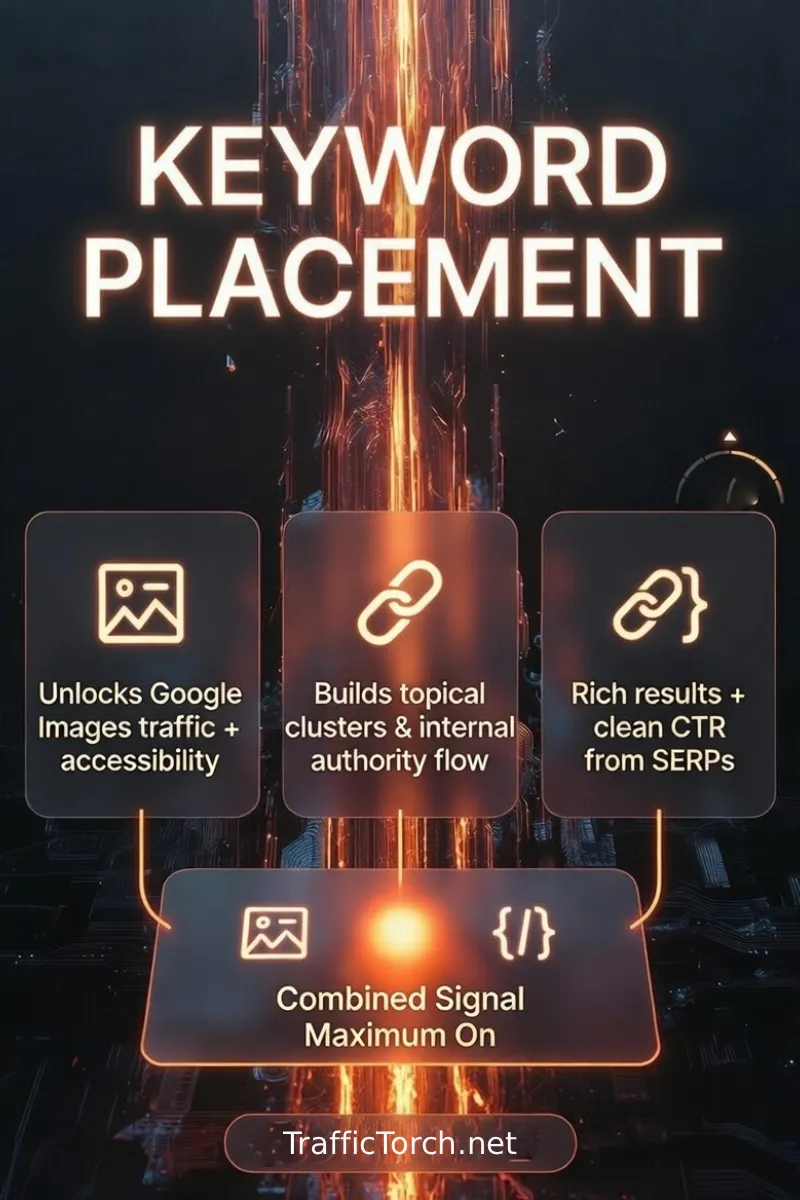
Adding descriptive, keyword-relevant alt text to your important images is still a meaningful ranking factor in 2026, especially for Google Images traffic, accessibility compliance, and overall page topical relevance. While alt text is no longer a massive ranking booster like it was pre-2018, well-optimized alts can drive 10–30% additional organic traffic from image search and help pages appear in multimodal AI results.
What Is It?
The alt attribute (alternative text) is a short description added to every <img> tag. It tells search engines and screen readers what the image shows when the image itself cannot be displayed or seen.
Alt text became mandatory for accessibility with WCAG 1.0 in 1999. Google started treating it as an image SEO signal around 2007–2008 (post-Universal Search launch). Key evolution milestones:
- 2010–2015: Alt text with exact keywords was heavily weighted for image rankings.
- 2018–2020: Google shifted emphasis to visual understanding via neural networks (less keyword stuffing tolerance).
- 2022–2026: Helpful Content + multimodal AI updates → descriptive, natural alt text now supports both accessibility and contextual relevance in Google Lens, AI Overviews, and image packs.
Today alt text serves three primary purposes:
- Accessibility: WCAG 2.2 AA compliance (screen readers).
- SEO: Contextual signal + Google Images traffic.
- UX fallback: Shows when images fail to load (slow connections, data saver mode).
How Traffic Torch Tests?
The tool performs a fast, client-side scan of your live page:
-
✓
Total image count: Identifies all
<img>elements on the page. -
✓
Keyword presence: Checks alt attributes for exact phrase or cleaned variant matches.
-
✓
Relevance filter: Shows up to 5 matching alts + highlights important images (those with width/height ≥ 100px or in main content).
-
⚠
Missing alt warning: Flags images without alt or with empty alt="" on meaningful images.
-
⚠
Decorative vs content images: Notes best-practice alt="" for purely decorative images.
Testing follows Google Images SEO best practices and W3C/WAI alt text guidance.
Why It Matters for SEO & User Experience?
SEO Impact
- Google Images traffic: Optimized alts can drive 10–30% extra organic visits (especially visual niches).
- Page relevance signal: Helps Google understand image context in multimodal search.
- AI Overview inclusion: Descriptive alts improve chances of images being referenced.
UX & Business Impact
- Accessibility compliance: WCAG requirement → avoids legal risk & improves inclusivity.
- Slow-connection fallback: Meaningful alts shown when images don’t load (huge in mobile-first markets).
- Trust & professionalism: Polished sites with proper alts appear more credible.
Anchor Text
Using your target keyword (or close natural variations) in internal anchor text remains an important on-page and site architecture signal in 2026. Descriptive, keyword-relevant anchor text helps Google understand page relationships, strengthens topical clusters, and improves crawl efficiency. Well-optimized internal links can lift site-wide authority flow and user navigation, indirectly supporting higher rankings.
What It Is & Its Evolution.
Anchor text is the visible, clickable text inside an <a> tag that users see and click. For internal links (same domain), it tells both users and search engines what the linked page is about.
Anchor text became a core ranking factor with Google’s original PageRank algorithm (1998). It was heavily abused in the 2000s (exact-match over-optimization), leading to major crackdowns:
- 2012 Penguin update → penalized aggressive exact-match anchor text.
- 2016–2019 → shift toward natural, branded, and partial-match anchors.
- 2022–2026 → Helpful Content + entity-based ranking → focus on semantic relevance, topical clusters, and user-first linking.
Modern philosophy: internal anchor text should be descriptive, natural, and helpful, ideally containing the target keyword or strong semantic variant when contextually appropriate.
How Traffic Torch Tool Tests It?
The tool scans your live page DOM for internal linking patterns:
-
✓
Internal link detection:Identifies
<a>tags where href starts with same domain or relative path. -
✓
Anchor text analysis: Checks visible text for exact keyword phrase or cleaned variant matches.
-
✓
Display sample: Shows up to 5 matching anchors with truncated text and href for context.
-
⚠
Zero matches warning: Flags when no internal anchors use the keyword (missed opportunity for relevance reinforcement).
-
⚠
Over-optimization check: Notes suspiciously high density of exact-match anchors (rare but still flagged).
Methodology aligns with Google’s internal linking guidance and Moz’s internal linking best practices.
Why It Matters for SEO & User Experience in 2026?
SEO Impact
- Topical cluster reinforcement: Keyword anchors help Google map site architecture and entity relationships.
- Link equity distribution: Passes contextual relevance signals between related pages.
- Crawl efficiency: Descriptive anchors guide crawlers to important content faster.
UX & Business Impact
- Intuitive navigation: Clear anchor text reduces clicks to wrong pages → lower bounce rate.
- Dwell time improvement: Users follow relevant links → stronger behavioral ranking signals.
- Conversion path support: Strategic internal linking guides visitors toward key actions.
URL & Schema Markup
Including your target keyword in a clean, readable URL (hyphen-separated) and implementing structured data (JSON-LD schema) are still high-impact on-page signals in 2026. Keyword-rich URLs improve perceived relevance and CTR from SERPs, while schema enables rich results (stars, FAQs, carousels), boosting visibility by 20–50% in many niches. Traffic Torch checks both to help you capture these easy wins.
What It Is & Its Evolution?
The URL is the unique web address of your page. Schema markup (usually JSON-LD) is structured data embedded in the <head> or <body> that helps search engines understand content type, entities, ratings, FAQs, products, articles, and more.
Clean URLs became important with Google’s early indexing (2000s). Keyword inclusion in URLs was a strong signal until ~2012. Schema.org launched in 2011 (joint effort by Google, Bing, Yahoo), and rich snippets exploded after 2015–2016.
Key modern milestones:
- 2017–2020: Mobile-first indexing → short, readable URLs became even more critical.
- 2021–2023: Passage Indexing & MUM → schema helps identify entity-rich passages.
- 2024–2026: AI Overviews, rich results expansion, zero-click SERPs → schema is now essential for visibility in carousels, knowledge panels, and generative answers.
Best practice today: keyword-focused slugs + relevant schema (Article, FAQPage, HowTo, Product, LocalBusiness, etc.) for maximum SERP real estate.
How Traffic Torch Audit Tests?
The tool evaluates both signals with lightweight, client-side checks:
-
✓
URL keyword match: Splits URL path by hyphens/spaces, counts exact phrase + cleaned variant (stop-word removed); partial credit if ≥50% of key terms appear.
-
✓
Schema detection: Searches for
<script type="application/ld+json">tags anywhere in the document. -
✓
Schema validity hint: Basic presence check (full validation would require external API call; we keep it instant).
-
⚠
No keyword in URL: Common on migrated or legacy sites; flags opportunity.
-
⚠
No schema detected: Misses rich results; suggests Article/FAQPage as starting point.
Aligned with Google’s structured data intro
Why It Matters for SEO and UX in 2026 and Beyond?
SEO Impact
- CTR from SERPs: Keyword in URL + rich snippets = 20–50% higher click-through in many verticals.
- Rich results eligibility: Schema unlocks stars, FAQs, how-tos, carousels, knowledge panels.
- Entity & topical clarity: Clean URLs + schema reinforce page intent for AI-driven ranking.
UX & Business Impact
- Trust & expectation: Descriptive URLs reduce hesitation before clicking.
- Enhanced SERP visibility: Rich results take more screen space → higher brand exposure.
- Voice & mobile search: Schema helps appear in spoken answers and mobile carousels.
Master On-Page Keyword Optimization in 2026
Keyword optimization is no longer about stuffing, it’s about creating relevance, satisfying user intent, and delivering exceptional experiences. The six modules covered here - Meta Title & Description, H1 & Headings, Content Density, Image Alts, Anchor Text, and URL & Schema represent the highest-leverage on-page factors still driving rankings today.
Key Takeaways
- Natural & user-first: Prioritize clarity over exact-match density.
- Holistic signals: All six elements work together to reinforce topical authority.
- Measurable wins: Fixing these often yields 20–60% CTR and ranking improvements.
- Ongoing process: Audit regularly, especially after content updates or algorithm shifts.
Next Steps
- Run a free audit on your most important page.
- Implement the top-priority fixes shown in your report.
- Monitor changes in Google Search Console (CTR, impressions, position).
- Re-audit after 2–4 weeks to track progress.
Related reading:
Keyword Competition Tutorial • AI Search Optimization Guide • Traffic Torch SEO Help Guides
Test your website SEO Keywords.
Run an instant seo audit on Traffic Torch.
Free SEO Keywords analysis Tool →